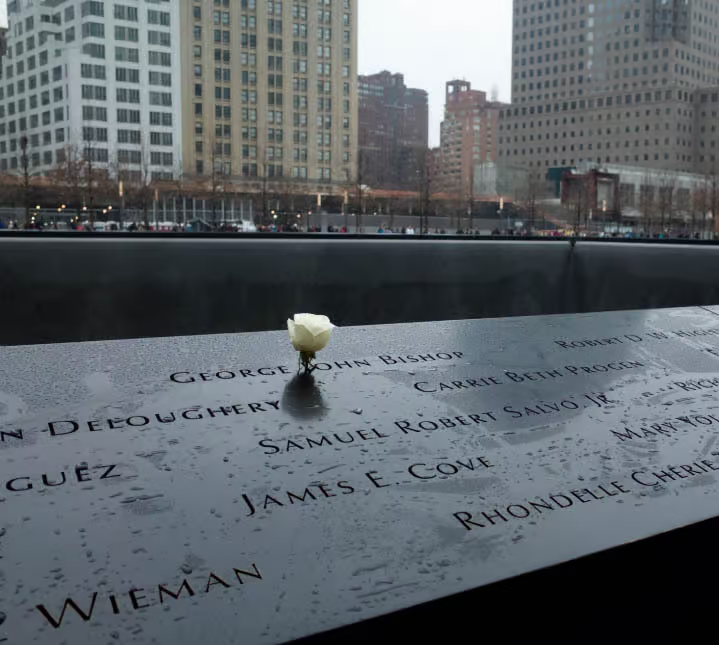
Congress approves a $15 billion federal aid package for the battered US airline industry, and sets up a government fund to compensate 9/11 victims’ relatives. [Los Angeles Times, 9/22/2001] However, relatives are only allowed to sue US-designated terrorists, and if they sue anyone else, they are not entitled to any compensation money. The law also limits the airlines’ liability to the limits of their insurance coverage—around $1.5 billion per plane. [Los Angeles Times, 1/17/2002] Nevertheless, some later sue entities that make them ineligible for the fund, such as the Port Authority, owner of the WTC.
September 10, 2002: Port Authority Sued by Victims’ Relatives and Insurance Companies for 9/11-Related Failures
Right before the expiration of a one-year legal deadline, the Port Authority, the government body that owns the WTC complex, is sued by five insurance companies, one utility and 700 relatives of the WTC victims. The insurance companies and utility are suing because of safety violations connected to the installation of diesel fuel tanks in 1999 that many blame for the collapse of WTC Building 7. [Dow Jones Business News, 9/10/2002] The relatives’ lawsuit is much more encompassing, and even blames the Port Authority for the Flight 93 hijacking (the Port Authority owns Newark airport, where the flight originated). The relatives’ lawsuit is likely to lie dormant for at least six months as evidence is collected. Relatives are also considering suing the airlines, security companies, and other entities. [Newsweek, 9/13/2002]
September 18, 2002: 9/11 Victims’ Relatives Raise Questions about US Agencies’ Conduct
Two 9/11 victims’ relatives testify before the Congressional 9/11 inquiry. Kristen Breitweiser, whose husband Ronald died at the WTC, asks how the FBI was so quickly able to assemble information on the hijackers. She cites a New York Times article stating that agents descended on flight schools within hours of the attacks. “How did the FBI know where to go a few hours after the attacks?” she asks. “Were any of the hijackers already under surveillance?” [MSNBC, 9/18/2002] She adds, “Our intelligence agencies suffered an utter collapse in their duties and responsibilities leading up to and on September 11th. But their negligence does not stand alone. Agencies like the Port Authority, the City of NY, the FAA, the INS, the Secret Service, NORAD, the Air Force, and the airlines also failed our nation that morning.” [US Congress, 9/18/2002] Stephen Push states, “If the intelligence community had been doing its job, my wife, Lisa Raines, would be alive today.” He cites the government’s failure to place Khalid Almihdhar and Nawaf Alhazmi on a terrorist watch list until long after they were photographed meeting with alleged al-Qaeda operatives in Malaysia (see January 5-8, 2000 and Shortly After). [MSNBC, 9/18/2002]
May 7, 2003: NIST Investigators Issue Progress Report; Say Tests Were Not Conducted Regarding How WTC Would Cope With Major Fire
At a press briefing in New York City, the National Institute of Standards and Technology (NIST) releases a 122-page progress report on its investigation into the WTC collapses. NIST began its study in August 2002 (see August 21, 2002). Investigators say they believe that the Port Authority of New York and New Jersey, who built the Twin Towers, failed to carry out vital tests to establish how the buildings would cope with a major fire. They have been unable to find evidence that tests were conducted on the fireproofing material used in the buildings. Their report also states that in 1969, builders directed contractors to coat the WTC floor supports with half an inch of spray-on fireproofing. In 1999, the Port Authority issued guidelines to triple the thickness of the fireproofing, and by 9/11, about 30 floors in the upper areas of the two towers had been upgraded. Almost all the floors in the impact zone of the North Tower had their fireproofing upgraded, while in the South Tower just the 78th floor—the lowest in its impact zone—had been upgraded. As the New York Times states, though, “investigators took great care… to say they were nowhere close to definitively determining how and why the towers collapsed after they were struck by hijacked airliners.” [National Institute of Standards and Technology, 5/2003, pp. 81; National Institute of Standards and Technology, 5/7/2003; Guardian, 5/8/2003; New York Times, 5/8/2003]
May 23, 2007: $2 Billion Settlement Ends Long Dispute Over WTC Insurance
Insurance companies reach a $2 billion settlement with real estate development and investment firm Silverstein Properties for the destruction of the World Trade Center on 9/11. The agreement, which involves seven of the two-dozen insurers for the WTC, ends more than five years of legal wrangling. The other insurance companies involved have already paid out about $2.55 billion, meaning the total payout will be $4.55 billion. In September 2006, Silverstein Properties and the New York Port Authority had agreed to split the reconstruction of the WTC site between them, and to divide up the remaining insurance proceeds accordingly. Consequently, the Port Authority is to receive about $870 million from the latest settlement, while the remaining $1.13 billion will go to Silverstein Properties. [New York State, 5/23/2007; New York Times, 5/23/2007; Newsday, 5/23/2007; Reuters, 5/23/2007] Silverstein Properties acquired the lease on several of the World Trade Center buildings, including the Twin Towers, in July 2001 (see July 24, 2001). [Port Authority of New York and New Jersey, 7/24/2001] As the New York Times summarizes, “At that time, two dozen insurers had signed binders pledging to provide $3.5 billion in insurance coverage, but had not finished the documentation.” Therefore, after 9/11, an “ugly dispute developed over which insurance policy was in effect at the time of the attack. Mr. [Larry] Silverstein [the president of Silverstein Properties] argued that since two jetliners slammed into the two towers, he was entitled to a double payment on the $3.5 billion policy. But many of the insurers countered that they had agreed to a different policy that did not permit double claims.” [New York Times, 5/23/2007] In 2004, federal juries had decided that Silverstein Properties could collect a maximum of $4.68 billion for the loss of the WTC. The current settlement therefore means the insurers are obliged to pay 97.2 percent of that maximum. [Bloomberg, 5/23/2007; New York State, 5/23/2007; Newsday, 5/23/2007; Reuters, 5/23/2007] Silverstein Properties had separately been awarded $861 million of insurance money in 2002 for the loss of World Trade Center Building 7, which also collapsed on 9/11 (see May 2002).