Editor’s Note: This paper is a Discussion of the flight simulator study conducted by researchers at the International Center for 9/11 Justice. The final report of that study can be found here. The Closure to this Discussion can be found here.
Because of the lengthy title, I will refer to the paper as the “flight simulator report,” or simply the “report.”
The flight simulator report adopts the following policy (although it does not follow it consistently):
For the sake of readability, this report will assume the 9/11 Commission and National Transportation Safety Board’s account of the aircraft identities, flight paths, and FDR retrievals to be accurate. Accordingly, repetitive qualifiers such as “alleged,” “reported,” and “purported,” though warranted, are omitted.
I will likewise omit those repetitive qualifiers here. We are all aware that every aspect of this topic is considered to be debatable by many people in the movement.
Overview
The flight simulator study was supposed to be an experimental test to see if the routes flown on 9/11 were feasible under manual control or whether they would have required automated control. Mythology tends to develop in any movement and one example is the claim that hitting the Twin Towers with large planes flying at high speeds would be extremely difficult. But is it true? The first result listed in the executive summary of the flight simulator report is, “Hitting the Twin Towers and the Pentagon under manual control and at high speed would not have been inherently difficult.” I immediately commented back, via email, that the corresponding conclusion of the report should be that manual control cannot be ruled out. But no. The report concludes that the results are consistent with computer control and not consistent with manual control.
If the experiment had found that the routes flown by the planes on 9/11 were impossible to have been flown under manual control, I would have recognized this as a legitimate statement of the experimental findings. However, it turns out that none of the maneuvers tested were found to be impossible under manual control, so the claim that the results were “not consistent with manual control” is a judgment call based on assumptions and an assortment of factors other than the actual experimental results. The paper thus ceases to be a report on an experiment and instead becomes polemical.
Some people have an intuition that the planes on 9/11 must have been flown automatically because the towers at the World Trade Center were pre-loaded with demolition charges, the airliner collisions were needed to play their role in the cover-up, and hijackers could not be trusted to carry out this mission. On the other hand, once we get away from the actual “feasibility-check” nature of the simulator experiment, there are many other sources of data that must be considered before a general solution can be agreed upon. A few cherry-picked arguments about what seems most reasonable, or what the perpetrators “would have done” short circuits the larger discussion. The role of this experiment (or any experiment) is to put a few data points on the table, not to close the books on the discussion.
The argument as stated in the report is that easy routes into the target buildings existed, but the routes flown on 9/11 were not the obvious easy paths, but instead added extra difficulty. One should observe that no two of the runs followed by the simulator pilots followed exactly the same path, and the same could be expected of flights under the control of human hijackers, so it is reasonable that human 9/11 hijackers followed non-optimal paths as a matter of human variability. However, the report argues that these more difficult paths must have been intentionally prescribed, constituting extra constraints on the pilots. So, after confirming that the most direct routes into the targets were easy, the task set for the simulator pilots was to duplicate what may have been the particular quirks that inadvertently made the actual flights more complicated. The report fails to justify the assumption that the planners knowingly prescribed maneuvers beyond the abilities of the hijackers. We have no way of knowing the actual intentions of the planners or the hijackers.
The use of the plural here (as in hijackers, flights, paths) can be misleading. The task set in the experiment for the simulator pilots, in relation to the Twin Towers, was to duplicate as closely as possible a single banked turn into the South Tower. That is the whole experiment for the case of the Twin Towers. It turns out that the 20° bank in the last 10 seconds was trickier to execute than expected and none of the simulator pilots succeeded on the first try. They did, however, do better on subsequent attempts. In other words, making sharp correcting turns at high speed (which is something the hijackers would likely have trained to do) involved a learning curve.
It would have been useful if the simulator experiment had played with that variable to learn about the steepness of the learning curve, but after several runs, including many successful ones, only the first failed attempts were used. The later successful runs were deemed irrelevant. The full data table is not even included in the report. It is in an external document accessed in an obscure link at the very bottom of the last appendix in the report. The report shows only the first (failed) attempts and the videos accompanying the report show only the same first failed attempts.
What I found upon accessing the full data table, was extremely interesting. All pilots failed on the first attempt.
- Pilot 1 succeeded in 3 out of 4 subsequent runs,
- Pilot 2 succeeded in 5 out of 5 of the subsequent runs,
- Pilot 3 had an ambiguous start, but then succeeded at 3 runs,
- Pilot 4 succeeded at 2 out of 2 subsequent runs,
- Pilot 5 had 3 runs overall and hit the building twice, but there were ambiguous factors,
- Pilot 6 hit the tower once with ambiguous conditions for all runs, and
- Pilot 7 succeeded in 1 out of 1 subsequent runs.
Displaying this information in the report would have allowed the reader to evaluate the decision to use only the first failed attempt. There is a serious lack of transparency here, especially since this decision materially affects confidence in the validity of the experiment.
The stated concern is that repeated attempts gave the simulator pilots an opportunity to hone their skills, whereas the actual hijackers would have only a single pass on 9/11. But the illogic goes even deeper. If the simulator pilots could learn to do a steeply banked correction maneuver at high speed after a few runs on a simulator, the actual hijackers could also be expected to master such maneuvers with a little simulator practice, and it is known that they did indeed have a significant amount of simulator practice.
An FBI document titled Hijacker Timeline cites numerous sessions on full commercial simulators for a variety of large planes. In particular, over two days, starting on 12/29/2000, Mohamed Atta and Marwan al-Shehhi (the two WTC hijacker pilots) paid $1500 for 727 simulator training in which they “requested only training on ‘executing turns and approaches’ but not other training normally associated with the course.” They had a third day training on a 767 simulator for which they paid $2500. The supposed low preparation of the hijackers is quite possibly another of the myths that have become embedded in the movement. Relying on the myth of the ill-prepared “amateur” hijackers artificially biases the interpretation of the simulator experiment against the feasibility of actual hijackings.
The issue in the case of UA175 is that the initial approach to the South Tower was too far to the east, and a sharp correction maneuver was used to swing the plane into the building. One question that might arise is, was the deviation accidental, due to a piloting error, or was there some rational purpose in approaching the building this way? The former possibility involves human error, and hence a human pilot. The latter possibility raises imponderables: why would such a path be planned in advance when there was more than adequate time to set up the alignment earlier as the plane rounded the southern end of its flight path and headed north toward Manhattan? The logic of the experiment rests on this assumption, but how would we know the intention of the planners?
If the deviation from the target was due to navigation issues or careless piloting, there is no other “explanation” needed. It would not have been a rational decision, knowable in advance, that could induce the planners to have second thoughts about using human hijackers. It would just be a potential near miss countered by an inelegant hard bank to avoid failure followed by a second even harder bank seconds before impact to improve the targeting. The planners would have seen the assignment as an easy hit, which was unexpectedly made harder by the hijacker pilot, saved by a last minute “Hail Mary,” or whoever would be hailed in an Islamic culture.
Why might this late 20° bank maneuver have been planned? The explanation offered by the report is speculative and not at all clear.
“These final maneuvers were inherently difficult, though not impossible, to successfully execute. The completion of them required precision flying that also likely necessitated prior knowledge of how the aircraft handled at high speed. On first attempt, by definition, the alleged hijackers could not have possessed this knowledge.”
We have already commented on the flawed “first attempt” logic.
The report continues:
“The reported final flight paths for all three aircraft [including AA11 here, which was not part of the experiment] are consistent with deliberate and precise targeting. Both of the aircraft that hit the Twin Towers were maneuvered in the final seconds so as to achieve a completely or nearly perpendicular path into the face of each building, impacting at or near the center. … The symmetry between the airplanes’ last-second dives, pull-outs, turns, and perpendicular line-ups is remarkable.”
Is this really the rationale in the minds of the perpetrators? How would we know? The report relies on the “remarkable” symmetry between the approach paths of AA11 into the North Tower and UA175 into the South Tower to justify the conclusion of “deliberate and precise targeting.” But this claim of symmetry is simply false. The flights really did not mirror each other. AA11 hit square in the center of the North Tower, but it was flying at a lower speed, hit higher in the building, and the final maneuvers were more gentle, better described as a refinement of the targeting rather than avoiding a near failure. If the argument of symmetry were a truly significant issue, why was AA11 not included in the experimental plan? This has the feel of scrambling, after the fact, to construct a rationale for the UA175 offset.
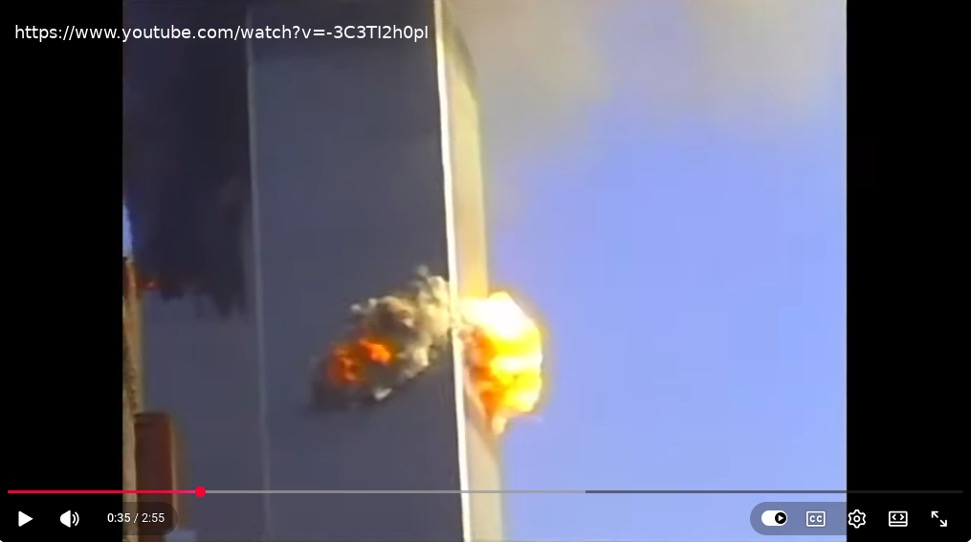
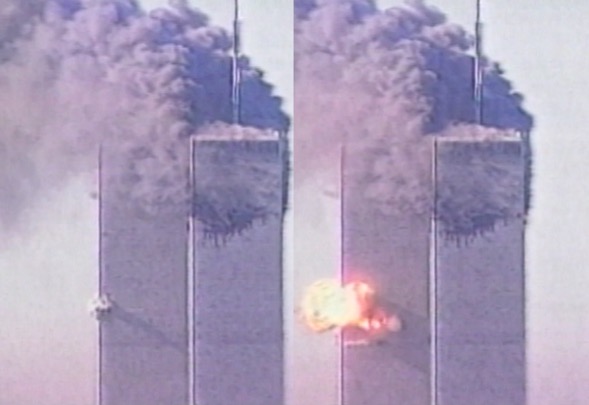
Despite the claim of “remarkable” symmetry, UA175 did not hit the South Tower in the center of the building or perpendicular to its face. Figure 1 shows the off centered impact, ~1/3 of the way across the south wall, with the fireball erupting along the east (but not the west) side of the building. The lateral angle of impact, according to Kobs, is 8°. This resulted in the plane only trimming the outer core columns on the east side leaving one of the staircases on the west side of the building damaged but usable, allowing 18 people on the upper floors to escape after impact. The off-centered impact is probably what accounts for the tipping of the top of the building when it is brought down nearly an hour later. Figure 2 shows the exit point on the north wall, almost precisely at the NE corner of the building. I don’t see an argument here for either symmetry with AA11 or precise targeting.
While reading through the report the first time, the whole symmetry issue made no sense to me. Why would the perpetrators, or anyone else, care whether two independent flights were performed in a symmetric manner? First of all, the flights were clearly not symmetric. One was a well-centered hit, the other definitely was not. One flew in perpendicular to the wall, the other did not. The speeds of the planes were different. The heights of impact were different. The amount of last-minute correction in the paths was different. These are apparently two independently planned and executed flights.
Given the obvious mismatch of the description and the reality, I started wondering about all of the inappropriate superlatives used to describe this situation, such as
- “deliberate and precise targeting” [precise for AA11; obviously imprecise for UA175],
- “completely or nearly perpendicular path into the face of each building” [perpendicular for AA11; obviously not perpendicular for UA175],
- “impacting at or near the center” [at the center for AA11; way off center for UA175],
- “the symmetry between the airplanes’ last-second dives, pull-outs, turns, and perpendicular line-ups is remarkable.” [the claim of symmetry appears contrived and irrelevant].
The author of the report appears to be attempting to convince the reader that what was most likely simple human variability, or even a navigation error (a salvaged near miss condition for flight 175), was an intentional maneuver, that was somehow important, but fraught with difficulty. So difficult, in fact, that human hijackers could not be trusted to succeed, leading the planners to reject the idea of using human hijackers and instead opt for remote control.
What I believe the planners saw in the planning for UA175 is an easy, straight shot at the South Tower, with no obstacles anywhere, and no reason to deviate from a direct approach. This is not something that would lead them to opt for automated control. What went wrong is not the complexity of the flight plan, but awkward execution. The flight should have lined up for the correct approach while still miles away. Instead, in setting up the final approach, they turned north too soon, so they were not lined up optimally with the south face of the South Tower. The hijacker pilot could have gone straight in anyway, regardless of the angle. A plane crunching into the face of the building at an angle is not a real problem. It is not an “elastic collision.” It would not “bounce” off. The pilot may not have understood this, however, so instead he seems to have opted to try a last-minute adjustment, which made the maneuver more difficult. What we are seeing is not perfectly executed automated control. I believe what we are seeing is poorly executed human control.
Given that the claims of symmetry and precise targeting are so obviously false, to anyone who looks at the visual data, I am left wondering why the author of the report framed the argument this way. This feels more like a sales pitch than a logical argument, but I’m not buying.
By the way, one last point on the approach path of UA175. When I was reviewing the early drafts of the report before it was published, I brought up the question of why a difficult pull-out to avert a near miss 10 seconds before impact would be interpreted as a sign of automated control. A computer should have aligned the path long before impact. I was told that coming in with precise alignment would be a tip-off that the flight was computer controlled, and the perpetrators wanted people to believe the flight was being controlled by human hijackers. That is the most outlandish explanation I have ever heard. The report itself states that human hijackers would be expected to fly along the easiest, most direct route. Here the argument is flipped. Alignment for a straight shot is now used as evidence of computer control.
Now I see that this “explanation” was actually added into the final version of the report. It says,
“They also avoided lining up so far out from the building that the perpendicular alignment would have looked intentional and impossibly precise for someone manually flying the aircraft.”
(If that statement was present in an earlier draft, I may have missed it.) The bottom line is, that is not an explanation at all. A salvaged near miss is not characteristic of automated control. Avoidance of a risky situation is. Adding this pseudo-explanation into the report makes it downright embarrassing.
The Pentagon
The second locus of the flight simulator experiment was the Pentagon. The significance of the Pentagon event, for the question of manual or automated control, is very different from the case of the Twin Towers. We all agree that the Twin Towers were prepped for demolition and failure to hit them with airplanes would have complicated the “spin” explaining why they fell. No such issue would be raised in the case of failure to hit the Pentagon. The crash was not a cover story for a demolition. It was a direct attack to inflict damage on a national symbol of power. A crash anywhere near the Pentagon would have had a similar propaganda effect, even though a direct hit would clearly be more desirable, from the perpetrators’ point of view.
The first issue addressed in the simulator experiment was whether an assignment to simply hit the Pentagon, starting from cruising altitude, with no other constraints, would be easy or hard. It turns out it was easy. Just aim, dive, and accelerate.
Evaluating the human fly-ability of the actual path taken on 9/11 was the next stage of the experiment and it involved two problems: the large 330° descending loop and the final straight but sharply descending final run into the Pentagon.
One outcome of the experiment was that the 330° turn itself was rated as relatively low difficulty, with a high degree of success among the simulator pilots. This result debunks one of the enduring 9/11 myths, that this was a difficult turn that would be difficult or impossible in a commercial jet.
The main difficulty that was noted in flying the loop was maintaining orientation when coming out of the turn and leveling out toward the Pentagon. The Pentagon is obvious by its unique shape, when seen from above, but simply looks like a large office building from the side. The fact that it sits in a depression adds to the difficulty. If the big loop was a planned maneuver in a manually controlled scenario, the hijackers, who had extensive training in simulators over several years, would have become aware of the disorientation issue, just as the simulator pilots in the experiment did. There are various plausible ways they could have overcome the problem:
- It is documented by FBI tracking of the activities of the hijackers prior to 9/11 that they had many hours of training in full-sized commercial simulators. It is documented that they paid thousands of dollars in cash (and credit cards) for these sessions, one of which lasted 12 hours. They knew how to use the instruments in the plane to calibrate their turn.
- The sought-for alignment, coming out of the loop, might not have been toward the Pentagon. Wayne Coste has pointed out that following the descending loop, the Pentagon and the US Capitol Building were in nearly perfect alignment. The Capitol might have been the primary target with the Pentagon as a target of opportunity, or the Capitol might have been the backup plan if they failed to hit the Pentagon.
- We don’t know that the route taken from the Ohio turn-around to Washington DC went exactly as planned. If there was a special motive to hit the south-west face of the Pentagon, as many have speculated, the intention may have been to arrive farther to the south, and from there to simply dive into the Pentagon. (The flight simulator experiment has shown this would be very feasible and easy to execute.) Seeing that they arrived farther to the north, they may have improvised the loop.
- My own favorite hypothesis is the hijackers pulled out of the loop too soon. If they had flown a slightly wider loop they would have been aiming at the Pentagon along the north edge of the Navy Annex, near the Arlington Cemetery fence. (Ironic, isn’t it?) This would have given them a clear shot at the Pentagon wall without the cluster of impact hazards along the way.
The Pentagon may not have been the intended target. Note that Flight 93, which was also heading for the DC area should have arrived before Flight 77, but it’s takeoff was significantly delayed, and as we know, it failed to show up in DC at all. It could well have been the plane intended to hit the Pentagon, and Flight 77 could have been intended to hit the US Capitol Building or some other target. Arriving in DC and seeing no smoke plume rising from any of the potential targets, Flight 77 may have prioritized the Pentagon as a change of plans.
If all of this sounds speculative, it definitely is. There is no way we can read the minds of a group of dead hijackers, or hidden behind-the-scenes planners. However, all of these scenarios, and possibly others, could have been flown manually. The bottom line is that the descending spiral, whatever the reason for its execution, does not rule out manual control, and nothing about the loop points to automated control.
Let’s turn to the final stretch after the loop with the plane aimed at the Pentagon. This was definitely a difficult path beset with hazards. It is a straight shot, but it involves a dive, with a pull-out at the end bringing the plane close to the lawn. As it crossed the Hwy 27 overpass it scooped out the top of a tree, scarred and nicked the rung off of a highway camera pole with its right wingtip, nicked a light pole with its left wingtip, causing it to fold and fall over without severing it, shattered four more light poles, two with each wing, impacted a chain link fence and a massive generator trailer with its right engine, impacted several cable spools and created an elliptical scar in a concrete retaining wall with its left engine, shattered the trunk of a mid-sized tree with its right wing strut, throwing the tree, trunk first, northward along the wall, and then crashed into the Pentagon wall. (Wayne Coste has detailed the damage pattern, continuing forward from that point in great detail as the plane entered and passed through the building. See https://911speakout.org/wayne-coste/.)
Did all of this go exactly as planned under computer control, or was this a “series of unfortunate events” that nearly crashed the flight, leaving plane parts and passenger bodies all over the Pentagon lawn? If the flight had come in just a few feet higher it would have missed most of the hazards. To me the fact that it failed to avoid the hazards is a clear case of a major “screw-up” with human pilot error written all over it.
Interestingly, the report argues that the path, as flown, is the work of automated control, because a human pilot would not have flown that low. That is an amazing conclusion. If a human pilot would not have risked flying through an obstacle course, why would a human programmer have seen it as a good idea to plow through all the obstacles and even plan it in advance? As bad as the damage was, it could easily have been a whole lot worse. The right wing nicked a large, strong, steel camera pole, designed to support the weight of a worker climbing the rungs. A few feet farther to the right and the right wing would be severely damaged, possibly causing the plane to crash on the lawn. A few feet farther to the left and the left wing would have hit the VDOT communication tower near the Navy Annex, aborting the flight even sooner. (There are some reports that the wing actually did do some damage to the tower.)
What about motive? The report assumes a clear motive to target the southwest wall and to avoid hitting the sections of the Pentagon occupied by the “big brass.” All of this sounds very plausible, under the assumption that major Pentagon figures were among the real perpetrators, but the motive is still pure speculation, not something derived from the experiment. Key figures could well have been in bunkers. If Donald Rumsfeld had survived despite having his office hit, it might even make him a sympathetic figure, if you can imagine such a thing. Bottom line, we cannot read the minds of the dead hijackers or the hidden perpetrators. Motives for any of this are all speculative.
Was anything learned from the Pentagon component of the simulator experiment? Yes.
- The loop was definitely flyable, debunking a longstanding 9/11 myth.
- There was unexpected difficulty maintaining orientation when coming out of the loop.
- Hitting the Pentagon close to the ground was harder than one might have guessed.
- (Whether some kind of terminal navigation aid, such as a beacon, could have been used has been discussed in the past, but was not explored or even mentioned in this report.)
- The motives for hitting the Pentagon, a symbol of US. power, are pretty obvious. The motives for hitting the southwest wall are only speculative.
Nothing about the final approach to the Pentagon points to automated control. The fact that the report reaches for that conclusion despite the litany of improbabilities and near catastrophes is evidence of an interpretive bias.
Wider Concerns
In this response to the flight simulator report I was initially intending not to bring up issues that diverge from the reporting of the actual experiment, but the report itself raises these divergent issues.
In the Conclusions and Further Research section the report takes the discussion to a different level:
“More widely, evidence in support of the automated control hypothesis links with other issue areas that require continued and fuller examination. These include the veracity of the alleged hijacking events (Davidsson, 2013; Walter, 2024; Ryan, 2023), evidence about whether the alleged hijackers actually boarded the aircraft in question, and intelligence agency surveillance of and facilitation of the alleged hijackers in the lead-up to 9/11.”
Much of the wider discussion surrounding this experiment questions the presence of hijackers or hijackings at all, but as I have pointed out, those hypotheses are not within the scope of this experiment or supported by the experimental evidence, which is concerned only with the final approach to the various targets. So why are those issues raised here at all?
Furthermore, the “no hijacker” claim requires dismissing vast amounts of evidence including,
- phone calls from the planes (which testify to hijackers armed with guns, knives, and even a bomb on the plane),
- the flight 93 cockpit voice recorder (that contains the voices of hijackers and signs of a struggle),
- ATC (Air Traffic Control) communications (that also contain voices of hijackers and a May Day call from one of the original pilots during the struggle),
- DNA evidence of hijackers at all of the crash sites,
- FDR evidence of erratic control of flight 77 during the portions of the flight where the autopilot was turned off,
- FDR evidence for radical rapid changes in pitch and roll in Flight 93 during the time when the phone calls, the cockpit voice recorder, and the ATC recordings speak of a passenger revolt, suggesting an attempt to quell the revolt,
- eyewitness testimony from a small plane pilot in ongoing contact with the ATC describing the wild variations in pitch and roll of flight 93 during the time of the passenger revolt, a 180° roll and steep dive of flight 93 attested to by both the FDR and eyewitness testimony, and
- changes in the horizontal stabilizer of flight 93 corresponding with shifting mass to the back of the plane following the hijacking when passengers were herded to the back of the plane, and shifting mass to the front of the plane at the onset of the passenger revolt, as a group of passengers rushed forward in an attempt to storm the cockpit.
The flight simulator experiment involves only the manual fly-ability of the final approaches to the South Tower and the Pentagon, and that is the only experimental evidence gathered, yet the conclusions are framed in terms of overall control of the flights, and the concluding remarks point down the road toward explanations based on claims of large bodies of faked evidence. Why?
The flight simulator report also diverges into questioning the authenticity and reliability of the recovered FDRs. I say “recovered” FDRs because the report makes some very puzzling comments about the Flight Data Recorders overall:
“Although FDRs for AA11 and UA175 were reported to have never been found, claims exist that they were recovered (Barrett and Bellone, 2011: p. 189). Further inquiries should be made into the possibility that these exist, followed by attempts to force the authorities to release the data. Information from these FDRs could provide additional evidence regarding the maneuvers carried out during the final minutes and seconds of flight, and this evidence could be cross-referenced with the evidence presented in this study.”
In other words, according to the report the flight data recorders we do not have could be important for our understanding of the event, and we should make efforts to get them released. But the report turns around and discounts the flight data recorders that we actually do have. The report looks at them this way:
“Generally, analysis based solely on the FDR data needs to consider the extent to which this data can be relied upon to make robust inferences regarding manual versus automated control. The FDR data was supplied in digital form and is, potentially, vulnerable to manipulation. In addition, the maneuvers indicated by the FDRs from UA93 and AA77 could just have easily been performed via remote or automated control as by manual control. The evidence for automated control of AA11, UA175, and AA77 — based upon the findings in this study, which draw upon a combination of different evidence — would suggest, at the very least, that FDR-based claims for UA93 and AA77 be treated with caution.”
This statement elevates the tentative conclusions of this study over the massive amounts of data cited above. This paragraph also ignores the extensive research a long line of researchers (including myself) have conducted in examining the contents of the AA77 and UA93 FDRs, and misrepresents that work as “based solely on the FDR data.” For an account of that research see https://scientistsfor911truth.com/recent-research. Nothing in this experiment sheds any light on the FDR data, so why is the FDR discussion even presented here? There is a lot to be said about the FDR data we have, and the potential value of the FDR data that has been withheld, but none of that arises in the context of this experiment. The only rationale I can find for mentioning the FDR data in this context is damage control, given that the FDR data tends to contradict the results of this study. The words used in the report in regard to the FDR are that it should be “treated with caution,” but in fact the report is dismissive of the FDR data, as well as the other major compilations of data cited above. There is no substantive discussion of the FDR data here at all, and it is not appropriate that there should be, given that this is supposedly a report of a flight simulator experiment.
Therefore, although I find the actual flight simulator experiments conducted by the small group of high and low experience pilots who participated in this study to be of some interest, I believe the findings in this study, “which draw upon a combination of different [vague and largely speculative] evidence,” are deeply flawed and should not be relied upon in forming firm opinions or as the basis for further work in this area. The totality of the evidence needs to be studied seriously and not dismissed lightly.