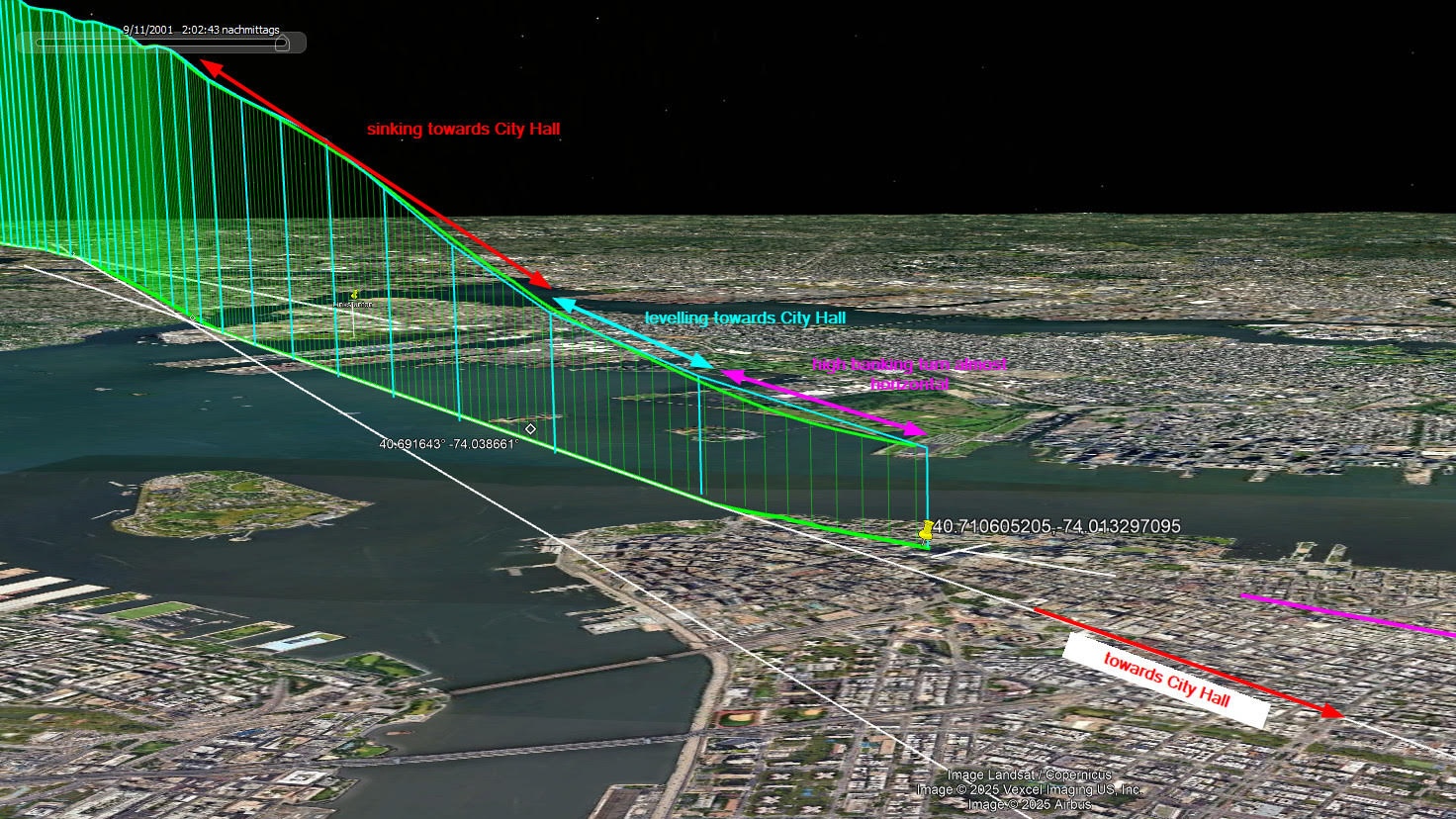
Editor’s Note: This paper is the Closure to a Discussion of the flight simulator study conducted by researchers at the International Center for 9/11 Justice. The final report of that study can be found here. The Discussion can be found here.
Overview
The IC911 study “Manual or Automated? A Flight Simulation Study and Analysis of Reported Aircraft Maneuvers on September 11, 2001” (FS Study) used “official reports, 3-D modelling of flight path data, and flight simulations performed by eight pilots in a full motion flight simulator” to “evaluate the likelihood of manual versus automated control” (which can include remote and precision computer guidance) of the three flights reported to have struck the Twin Towers (AA11 and UA175) and the Pentagon (AA77) on September 11, 2001 (FS Study, p. 3).
Summarizing the findings set forth in the 51-page FS Study report, we found that while intuitive and easy-to-fly routes—labeled the direct routes in the study—were available on 9/11, all three aircraft (according to official flight path data) followed counter-intuitive indirect paths to their targets and performed demanding last-second maneuvers that were unlikely to have been successfully performed by the alleged hijacker pilots on 9/11. We labeled these the indirect routes. The study also found that the indirect routes were consistent with the aircraft being maneuvered “deliberately and precisely” toward specific final impact paths and points. These paths and points were consistent with the likely objectives of the planners to (a) in the case of the Twin Towers, ensure that the aircraft impacted in ways that could reasonably give the appearance that the impacts had induced a gravitational collapse, and (b) in the case of the Pentagon, ensure that damage was limited to one section of the building. As part of our evaluation of the findings, we also considered alternative scenarios, all of which we found to be highly unlikely under the manual control hypothesis. Synthesizing these findings through inference to the best explanation, we concluded that the findings supported the automated control hypothesis and provided no comparable support for the manual control hypothesis.
These findings were also set in the context of what is now established regarding the controlled demolition of the Twin Towers and the logical inference that the planners, needing to guarantee the aircraft impacts as cover for the demolitions, would have been unlikely to rely upon hijacker pilots successfully boarding the aircraft, forcibly taking control from the pilots and maintaining control until reaching the targets, navigating the aircraft to and hitting the buildings in the correct way, and maintaining their intention to commit suicide throughout this process without at some point backing out. This logical inference makes the manual control hypothesis substantially less likely even before the results of our study are considered. The findings of our study, by providing new evidential and analytical grounds for favoring the automated control hypothesis, further increase our confidence in it and make it very unlikely the manual control hypothesis is true.
In his response, David Chandler challenges our analysis and conclusions on five grounds:
- He argues that the study’s principal conclusion should be that manual control is not ruled out and not that the automated control hypothesis is better supported.
- He argues that our focus on first attempts by the simulator pilots biased the research in favor of the automated control hypothesis.
- He argues that the study falsely claims there were observable symmetries regarding the flights paths of the aircraft that hit the Twin Towers.
- He argues that plausible manual control-related scenarios exist for the 330-degree descending turn allegedly performed by AA77 during its approach to the Pentagon.
- He argues that AA77’s reported final extremely low-level flight into the Pentagon is not consistent with deliberate and precise targeting.
In a closing section, Chandler also criticizes the study’s discussion of areas for further research and its treatment of Flight Data Recorder (FDR) data.
We will address each in turn.
1) “Manual Control Cannot Be Ruled Out”
In Chandler’s response as well as in comments he submitted during the review process, he argues that the study’s principal finding should be that “manual control cannot be ruled out” and not, as the study concludes, that the automated control hypothesis is better supported by the evidence. Specifically, his response begins as follows:
The flight simulator study was supposed to be an experimental test to see if the routes flown on 9/11 were feasible under manual control or whether they would have required automated control.
Mythology tends to develop in any movement and one example is the claim that hitting the Twin Towers with large planes flying at high speeds would be extremely difficult. But is it true? The first result listed in the executive summary of the flight simulator report is “Hitting the Twin Towers and the Pentagon under manual control and at high speed would not have been inherently difficult.” I immediately commented back, via email, that the corresponding conclusion of the report should be that manual control cannot be ruled out. But no. The report concludes that the results are consistent with computer control and not consistent with manual control.
If the experiment had found that the routes flown by the planes on 9/11 were impossible to have been flown under manual control, I would have recognized this as a legitimate statement of the experimental findings. However, it turns out that none of the maneuvers tested were found to be impossible under manual control.
This statement contains two flaws. First, in the very first sentence, Chandler mischaracterizes the study’s research question by creating a false dichotomy under which the routes flown on 9/11 either were feasible under manual control or were not feasible and thus required automated control. (Besides creating this false dichotomy, Chandler’s statement implies an illogical assumption that only if the routes flown on 9/11 were deemed beforehand to be infeasible would the planners of 9/11 have opted for automated control of the flights. As set forth above, there are several logically inferred reasons the 9/11 planners would have been unlikely to rely on hijackers to carry out the airplane attacks on the Twin Towers. None of these reasons have to do with the difficulty level of the specific routes flown on 9/11 but rather with the general unpredictability and unreliability of hijackers accomplishing the series of feats that comprise the official account of the airplane attacks, given that the planners would have required a high degree of certainty of successful takeovers and successful plane impacts into the Twin Towers.)
Having established this false dichotomy, Chandler then asserts that the study’s primary conclusion should be the first of the two available conclusions, namely that the routes flown on 9/11 were feasible under manual control. In reality, the study evaluated the degree of difficulty of the maneuvers performed on 9/11 and the likelihood of the manual control versus automated control hypotheses. Contrary to the flawed logic of Chandler’s false dichotomy, one does not need to rule out one hypothesis in order to conclude that another hypothesis is better supported or more likely. True to this principle, the report notes in three places (pp. 4, 44, and 45) that manual control cannot be ruled out with certainty while ultimately concluding that the evidence “fits better with the automated control hypothesis than with the manual control one” (p. 46).
The second flaw in Chandler’s opening is that the FS Study finding he cites—namely, that hitting the buildings would not have been inherently difficult—concerned the direct route runs, in which pilots were instructed to fly “in a way that they judged to be the easiest” to hit the buildings (FS Study, p. 10). Those runs, therefore, did not involve flying the flight paths or maneuvers observed on 9/11. By contrast, in the indirect route runs, pilots attempted to fly the actual maneuvers observed on 9/11. (Contrary to Chandler’s claim that the task was to “duplicate as closely as possible a single banked turn into the South Tower,” the actual task was simply to change course from the offset at approximately 10 seconds out and successfully impact the South Tower at any point on the building. The task was not to “duplicate” every aspect of the banked turn or the precise final path and point of impact.) Here the results and analysis, while not ruling out manual control as impossible, provided far more support for automated control. Indeed, none of the pilots in the study, regardless of experience level, completed the indirect route maneuvers on first attempt. Our analysis concluded that these maneuvers were 1) “inherently difficult though not impossible” to complete, 2) required “precision flying that also likely necessitated prior knowledge of how the aircraft handled at high speed,” which would have been unavailable to any pilot on first attempt, and 3) if attempted by the alleged hijackers on 9/11, “one would reasonably expect the pilots to fail” at completing them (FS Study, pp. 3–4 and pp. 23–28 for detailed analysis).
As such, although Chandler accurately quotes the study’s finding concerning the direct routes, he presents that finding in a way that obscures the study’s separate finding concerning the indirect routes—the condition most directly relevant to the question he is discussing. This selective presentation falsely makes the study’s overall conclusion appear unreasonable at the outset.
Chandler then immediately goes on to write that, because the study did not find the manual routes and maneuvers to be “impossible”:
. . . the claim that the results were not “consistent with manual control” is a judgement call based on assumptions and an assortment of factors other than the experimental results. The paper thus ceases to be a report on an experiment and instead becomes polemical.
He then claims a few sentences later that our arguments were “cherry-picked” and that the report attempts to “short circuit” and “close the books” on the “larger discussion” of the piloting of the aircraft.
What Chandler is referring to here are the study’s findings and analysis regarding the availability of easy-to-fly direct routes, the evident difficulty and counter-intuitiveness of the indirect routes actually flown on 9/11, the consistency of the final flight paths and impact points with deliberate and precise targeting, and the overall evaluation—inference to the best explanation—of these and other observations, all of which were found to provide support for the automated control hypothesis and no comparable support for the manual control hypothesis.
Here, however, before having engaged directly with any of these findings and analysis—which includes information from the flight simulator runs, detailed modeling of the flight paths, and consideration of relevant information regarding the demolition of the Twin Towers and the Pentagon attack—Chandler has summarily dismissed them by referring to them vaguely as based on “assumptions,” “judgement calls,” and an “assortment of factors,” and then claimed they involved “cherry-picked arguments” and that the study is “polemical.” (Note here that evaluation of evidence and developing inferences to the best explanation are not synonymous with being polemical.) Later in the response, when he does engage with a few issues related to our analysis, his arguments are, as we shall see, not well-reasoned.
Here in his opening statement, however, the summary dismissal of the rest of the study’s findings, labeled as “polemical,” works to underpin his opening argument that our study’s conclusion—namely, that the automated control hypothesis is better supported by the evidence—is unreasonable. His use of the term “polemical” is misleading because it leads the reader to believe our analysis is not based on reason and evidence.
In sum, Chandler’s opening criticism of the study—questioning its conclusion regarding support for the automated hypothesis and arguing the conclusion should be that manual control cannot be ruled out—is based on creating a false dichotomy, obscuring the most relevant findings regarding the flight paths, and then dismissing the rest of the findings as “polemical.” This is a very misleading framing and amounts to a misrepresentation of the study.
2) Focus on First Attempts
The first specific issue Chandler raises concerns the study’s focus on whether or not pilots succeeded in completing their maneuvers on first attempt. He raises this matter in relation to the South Tower indirect route only. Chandler argues this focus is invalid because the alleged hijackers might have learned to perform the last-second demanding maneuvers in simulators prior to flying them for real. In support, he cites the fact that the alleged hijackers purportedly had significant time on flight simulators during which they could train to fly the maneuvers. Here he accuses us of “relying on the myth of the ill-prepared ‘amateur’ hijackers artificially,” which he claims “biases the interpretation of the simulator experiment against the feasibility of actual hijackings.” Chandler also cites the study’s results table showing subsequent simulator runs by each pilot, arguing that they demonstrate the pilots learned to complete the maneuver successfully (FS Study, p. 51). Here we are accused of “a serious lack of transparency” because these results are contained in an attached results table and not in the body of the report.
Chandler’s reading of the results table is inaccurate while his substantive point does not engage with our justifications as to why the first attempt focus is warranted.
Regarding the inaccuracy, Chandler’s argument that the results table shows pilots successfully completing the South Tower maneuver is based on an incomplete reading of it. All of the simulator runs Chandler suggests show the successful completion of the maneuver actually involved pilots lining up too early. In these cases, rather than flying the required offset and initiating the turn into the tower when instructed to, pilots either lined up early leaving little or no offset or had already placed the aircraft in a turn prior to being instructed to “start the turn.” In short, in these cases pilots “completed” in the sense that they hit the South Tower, but did so by mitigating or avoiding the demanding maneuver—not by learning how to execute the maneuver. This is all documented in the results table in the columns headed “lined up too early” and “observations.” In fact, the tendency observed for pilots to turn or line up early is discussed in the report (p. 26) because it is significant evidence of the “counter-intuitiveness” of flying the offset route. The results table does not, therefore, evidence the “learning curve” described by Chandler.
Of greater importance here, however, is our rationale for focusing on first attempts. This was agreed during discussion with two highly-experienced pilots during the preliminary stage of the study and is set out on page nine of the report. The reasoning is as follows: We know the aircraft impacted the targets on first attempt, which means that, either through luck or skill, hijacker pilots would have pulled off the maneuvers without any previous real-world experience of handling a large jet at high speed while maneuvering in close proximity to their intended targets. Pilots flying second or third attempts would, potentially at least, learn from the first run and be more likely to complete the maneuvers, thus biasing the results in favor of completion. The conditions for subsequent runs, in short, would not be an accurate reflection of what happened on 9/11 and would have biased the results.
Chandler’s idea that hijacker pilots might have trained on simulators in order to perform the challenging last-second maneuvers fails to invalidate the focus on first attempts for two reasons. First, as explained in the report, the “possibility that the alleged hijackers practiced the maneuvers on a home or commercial simulator would not alter the fact that flying the maneuver in real life would have been different from previous practice attempts in a simulator, as handling of real aircraft will always be different when compared to a simulator” (FS Study, p. 9). Second, as set out on page 45 of the report, the idea that hijacker pilots might have planned to fly an offset until the final seconds of flight and intentionally place the aircraft in positions that involved demanding maneuvers that “inevitably increased the risk of mission failure is not logical.” Careful planning and practice in a simulator would have avoided this.
In his response, Chandler does not address these rationales for the focus on first attempts, even though they are clearly set out in the report. Instead, he simply asserts that the alleged hijackers “would likely have trained” to make “sharp correcting turns at high speeds.”
Falsely Attributed Assumptions
In making his criticism regarding the focus on first attempts for the South Tower, Chandler assumes that the automated control hypothesis entails that the demanding final maneuvers were fully pre-planned, prescribed, or a goal in and of themselves, and he erroneously attributes this assumption of his own to the study.
For example, he writes that the report “fails to justify the assumption that the planners knowingly prescribed maneuvers beyond the abilities of the hijackers,” thus causing the planners to “reject the idea of using human hijackers and instead opt for remote control” (as if controlling the behavior of would-be suicide hijackers intent on attacking the US could be readily managed in the first place). Elsewhere, he writes: “why would such a path be planned in advance when there was more than adequate time to set up the alignment earlier as the plane rounded the southern end of its flight path and headed north toward Manhattan? The logic of the experiment rests on this assumption, but how would we know the intention of the planners?” He also writes: “Why might this late 20°-bank maneuver have been planned? The explanation offered by the report is speculative and not at all clear.”
The scenarios Chandler presents variously blend two erroneous assumptions about the automated control hypothesis. The first assumption, already examined above, is that the planners chose automated control over human hijackers solely because hijackers could not be trusted to perform specific demanding flight maneuvers. The second assumption is that the demanding last-second maneuvers seen in the case of the South Tower were fully pre-planned and even an intended goal. Neither assumption is warranted and nor do we make them.
Regarding the first assumption, as already discussed above, there are a number of other logically inferred reasons why the planners would automate control of the planes. Therefore, when Chandler writes, for example, that the planners were led to “reject the idea of using human hijackers and instead opt for remote control” because they had prescribed a demanding last-second maneuver, he is evoking an implausible scenario that distorts the automated control hypothesis.
The second assumption—that the demanding last-second maneuvers seen in the case of the South Tower were an intended goal—is also unwarranted. In fact, the automated control hypothesis does not assume a scenario in which the demanding final-second maneuvers were fully pre-planned and an intended goal. A more likely scenario is that they were simply a function of having the aircraft aligned with specific final angles and points of impact, ensuring the aircraft went into the buildings the way the planners wanted them to. As such, it is plausible that the aircraft were navigated by remote control toward the vicinity of the intended targets—with any necessary real-time alterations being made as part of coordinating the attacks and other operational requirements—and then the aircraft were brought into precise alignment during the closing minutes and seconds. The fact that the aircraft, in order to accomplish this, ended up performing maneuvers that would have been challenging and counter-intuitive for a human pilot would not have been the intended goal, nor would it have been a matter of concern for the planners, as the difficulty of the maneuvers is not immediately obvious to the casual observer.
In short, Chandler incorrectly attributes to the study an assumption that the final challenging maneuvers themselves were an intended goal and excludes the possibility they were simply a function of maneuvering needed to have the planes hit the buildings in specific ways. The study, in fact, made no a priori assumptions regarding the planners’ intentions beyond their objective of having the aircraft hit the buildings in a way that would give the appearance the impacts caused the gravitational collapses. Chandler’s criticism that “the logic of the experiment rests on this assumption” is without basis.
Summing up, Chandler’s critique of the first attempt focus is based on an erroneous reading of the results table, fails to address the study’s actual explicitly stated rationale for its focus on first attempts, and employs unwarranted and incorrectly attributed assumptions.
3) Analysis of the Similarities (or Symmetries) Observed for the Paths of the Two Aircraft that Hit the Twin Towers
The second issue concerns the study’s finding that both AA11 and UA175 flew very similar trajectories during their final seconds. Specifically, both aircraft followed offset routes, flying to one side of each building, and then, within 10 seconds of impact, turned sharply toward a final path that was perpendicular to the face of the building being impacted and struck a central point in the building, while also simultaneously pulling out of a steep dive.
AA11 impacted the North Tower at the center-most column of the north face and perfectly perpendicular to the face of the building. Meanwhile, UA175 impacted the south face of the South Tower just 23 feet, or 11% of the width of the building, off of center (NIST NCSTAR 1-2B) and was only 8 degrees off of perpendicular (Kobs, 2026; see below).
The study found that these maneuvers were challenging—for example, all seven pilots failed on their first attempt—and that they were also counter-intuitive and unnatural for pilots. When asked to fly in a way they found easiest to hit the buildings, the pilots lined up early and flew straight at the buildings. And, as noted earlier, even when instructed to fly offsets, the pilots often lined up too early.
The study explains that these last-minute turns and line-ups, which make little sense from a piloting perspective, are explicable in terms of what we know about the controlled demolition of the buildings. It is logical that directing the aircraft toward central and perpendicular paths would have been intended in order to ensure the aircraft impacted fully, causing enough damage to reasonably give the appearance they induced the subsequent gravitational collapses of the buildings. Also, it is plausible that the controlled demolitions were designed around the aircraft impacting at specific heights as part of creating the illusion of the upper sections crushing the lower ones. This requirement plausibly explains the sharp pull-outs, which led to impact at specific heights.
Chandler’s principal objection here is that the two aircraft paths do not display any symmetries at all, citing the observations that UA175 did not hit perfectly centrally or perfectly perpendicular. He also notes that the speeds were different, the heights were different, and the “amount of last-minute correction in the paths was different,” from which he concludes they were “apparently two independently planned and executed flights.”
Chandler’s argument is exaggerated in two ways.
First, his critique here misleads both by listing two parameters—the speed of each aircraft and the amount of last-second correction—that are irrelevant to the argument at hand and then by ignoring the other key similarities, including the offset (instead of a direct approach) and the last-second sharp turns and pull-outs from dives.
Second, his rejection of our observation that UA175’s path was close to perpendicular, and its impact was close to center, also involves exaggeration. In order to support his claim that UA175 was “definitely not” a “well-centered hit,” Chandler shows two post-impact images (see below).
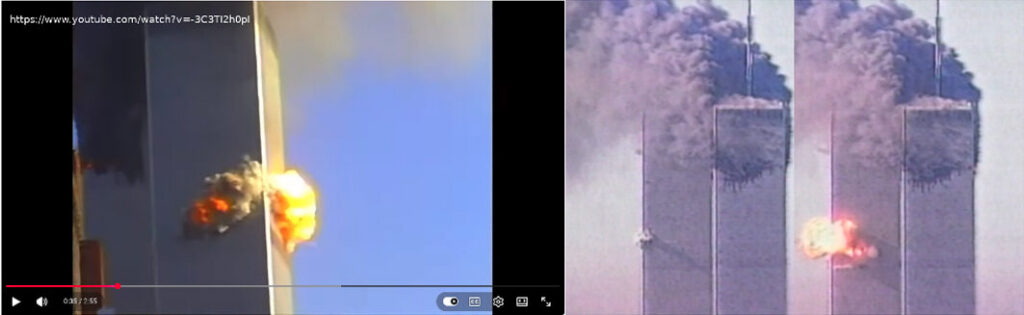
At first glance, the images appear to support his argument because they show an explosion out of one side of the building (see picture on left) and an exit of debris out of one corner of the building (see picture on right). The appearance of a well off-center impact is further reinforced by Chandler asking the reader to examine the image on the right and compare the exit explosion with “the higher and well-centered entry scar in the North Tower.” The presentation here inevitably risks leaving the casual observer with the impression that UA175 impacted at a steep angle and well off of center.
However, the juxtaposition of post-impact images is very misleading. First, the post-impact exit explosion out of the side of the building seen in the left image does not mean the impact was far off center. Second, asking the reader to compare the South Tower post-impact exit explosions with the entrance impact damage on the North Tower is misleading because the two are not directly comparable: One shows the entrance impact, the other the exit of debris out of the other side of the building.
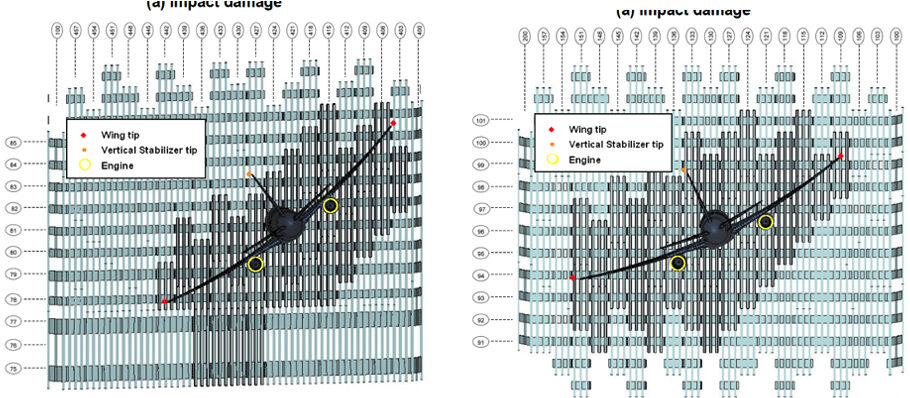
If one, instead, compares directly the entrance imprints for both Towers, it can be seen that UA175’s impact was, in fact, close to center and perpendicular while AA11’s was perfectly perpendicular and dead center. See images below:
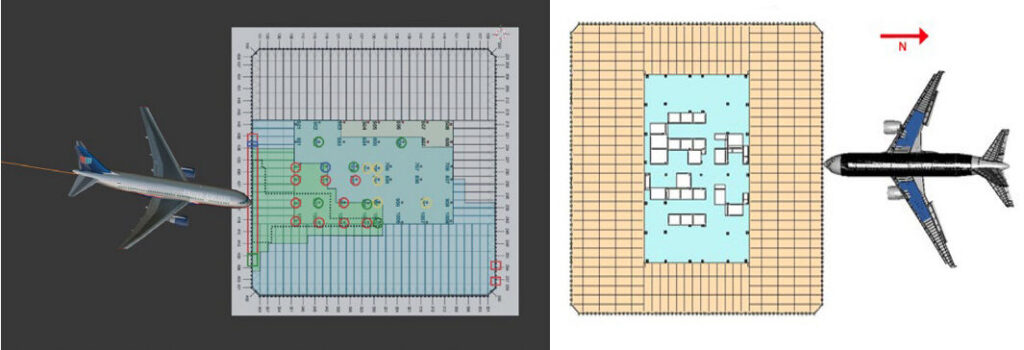
It is also important here that, when attempting to discount there being any observable similarities between UA175 and AA11, Chandler does not address our observation that both aircraft were maneuvered toward perpendicular paths by flying an off-set approach (see images below).
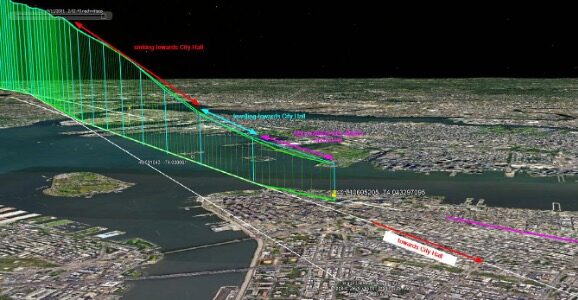
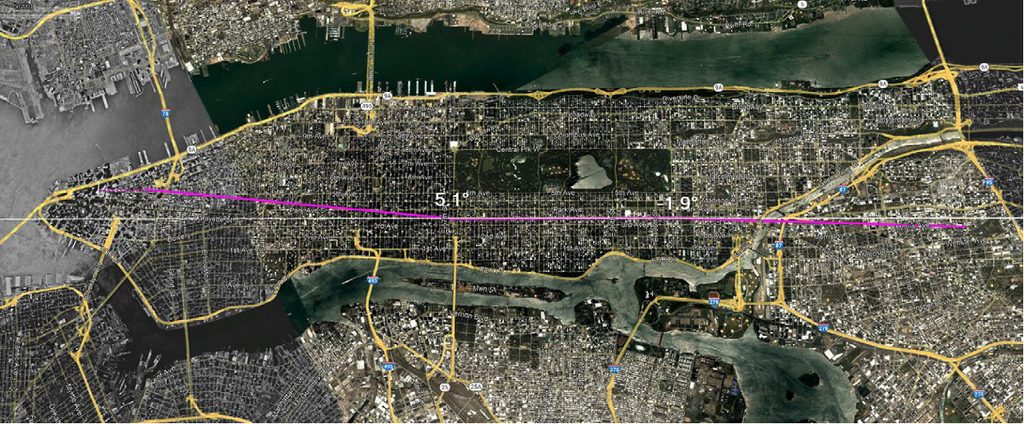
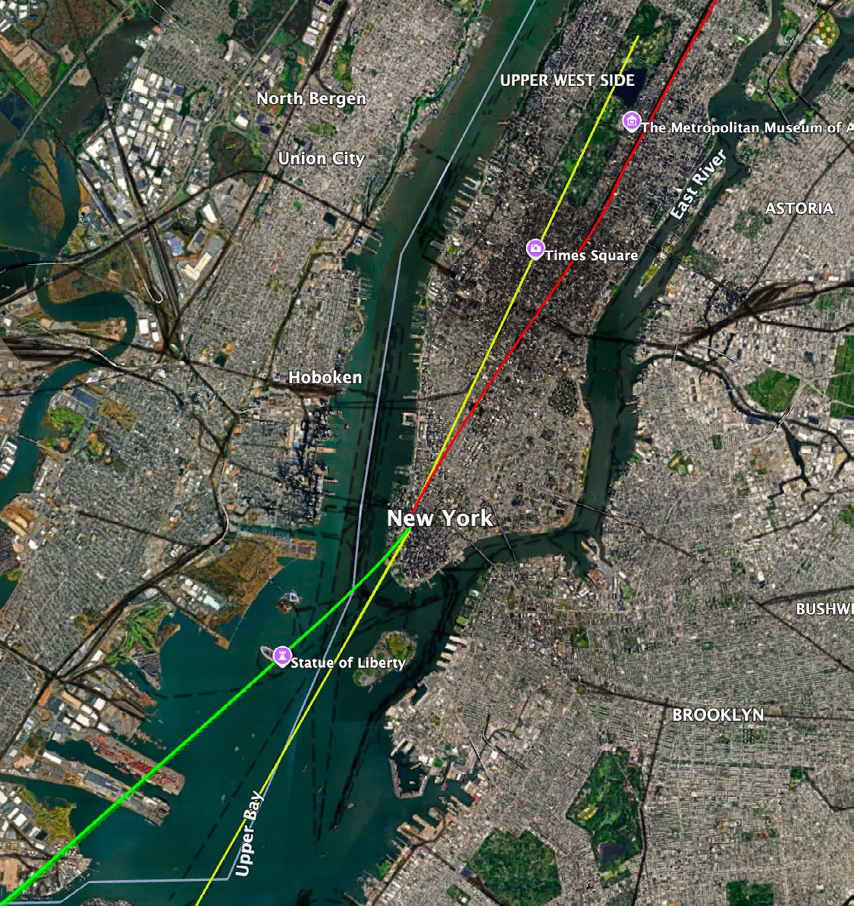
In sum, Chandler’s criticism—that there are no similarities/symmetries—involves a simple exaggeration of how far off center UA175 actually was as well as ignoring the observations that both flight paths show the aircraft being maneuvered toward perpendicular tracks in the final seconds. The fact that AA11 hits perfectly, while UA175 is slightly off, does not undermine the validity of the basic observations that the aircraft are being maneuvered toward perpendicular tracks and central points.
“By the way”
Chandler also attributes to us an “outlandish” “pseudo-argument” that he describes as “embarrassing.” The argument in question relates to our addressing the matter of why the planners would have sought a last-second alignment rather than lining up for a perpendicular and central impact much further away. Chandler writes:
I brought up the question of why a difficult pull-out to avert a near miss 10 seconds before impact would be interpreted as a sign of automated control. A computer should have aligned the path long before impact. I was told that coming in with precise alignment would be a tip-off that the flight was computer controlled, and the perpetrators wanted people to believe the flight was being controlled by human hijackers. That is the most outlandish explanation I have ever heard. The report itself states that human hijackers would be expected to fly along the easiest, most direct route. Here the argument is flipped. Alignment for a straight shot is now used as evidence of computer control.
First, there is a logical flaw here whereby Chandler conflates the study’s finding based on the direct routes results—that under manual control one would expect pilots to fly straight at their targets from whichever angle they were approaching from—with the argument about the aircraft maneuvering toward tracks that are perpendicular to the face of the building. The two are not the same. The argument that one would expect pilots to aim at the building does not mean that they would fly a track that is perpendicular to the face of the building. The claim, therefore, that we have “flipped” our argument is false.
Second, it is entirely reasonable to make the inference we do. The rationale is set out on page 40 of the report:
Referring again to Figures 21, 26, and 29 above, the flight paths show a series of small turns that function to bring the aircraft into alignment, eventually, with a perpendicular track into each tower. These changes are subtle and incremental, thus avoiding larger heading changes that may be suspicious and more likely to give away the apparent objective of lining up perpendicular to the towers. They also avoided lining up so far out from the building that the perpendicular alignment would have looked intentional and impossibly precise for someone manually flying the aircraft.
In short, Chandler’s dramatic and exaggerated claim about the analysis being “outlandish” and “embarrassing” is underpinned by his own erroneous conflation of “flying toward the buildings” with “flying a specific perpendicular track” and then by his failure to appreciate a straightforward argument that the planners could be expected to avoid having the aircraft fly in ways that gave away the intention to line up with a perpendicular track and that would have been impossibly precise for hijacker pilots to have performed.
4 & 5) The analysis of the reported flight path of AA77 into the Pentagon, including a) the 330-degree orbit, and b) the final low-level approach
Regarding the reported flight path of AA77 into the Pentagon, the study found that none of the pilots completed the combined 330-degree orbit and low approach on first attempt. Further, during subsequent attempts at the low-level approach only, the pilots were able to complete the maneuver only seven times out of 25 attempts. The study also established that a straightforward and easy-to-achieve approach was available. This approach involved simply descending straight toward the Pentagon, without any need for the 330-degree orbit, and then avoiding the extremely low-level path into the side of the building. Finally, the extremely low approach to the Pentagon, which involved the aircraft flying into the side of the building at extremely low level, was consistent with deliberate and precise targeting intended to avoid impacting other parts of the Pentagon. A higher and more angled approach would have risked the aircraft hitting other parts of the Pentagon (FS Study, p. 40).
As with the South Tower route, then, the study found a similar pattern of demanding and likely-to-fail maneuvers instead of straightforward and easy ones, coupled with their being consistent with precise targeting requirements, and concluded that this pattern supported better the automated control hypothesis than it did the manual control hypothesis.
Chandler challenges our analysis in two ways. First, he raises the possibility that hijacker pilots might have practiced flying the 330-degree orbit on home simulators, offering a variety of ideas as to why the 330-degree orbit might have been intentional under the manual control scenario. Second, he argues that the extremely low approach would not have been intended, either by hijacker pilots or by planners with automated control of the aircraft. We shall deal with each in turn.
The 330-Degree Orbit
Chandler presents a series of possibilities as to why a manually flown AA77 might have performed a 330-degree orbit in front of the Pentagon rather than avoiding risks of mission failure—whether through becoming disorientated during the 330-degree orbit (as was the case with some of the simulation runs) or increasing the risk of interception by delaying reaching the target—by simply flying straight at the Pentagon (as was seen with all of the direct runs in the simulator). These are as follows:
- The orbit was intended to bring AA77 into alignment with Capitol Hill and the Pentagon, thus allowing for the hijacker to decide between two targets. This idea is linked with a further suggestion that perhaps the hijacker pilot arrived in the area intending to hit Capitol Hill, but then seeing that the Pentagon was not hit by UA93, and assuming this was UA93’s planned target, elected to then crash into the Pentagon.
- The orbit resulted from “a special motive to hit the south-west face of the Pentagon” and, because they arrived too far north, “improvised the loop” in order to line up with the southwest face of the Pentagon.
- Finally, Chandler speculates that perhaps the hijacker pilot intended to approach further to the north but ended up pulling out of the loop too early, which led to the plane flying its approach just south of the Navy Annex.
Whether or not a hijacker pilot trained for the 330-degree orbit on home simulators, Chandler’s ideas about why one would fly such a maneuver are poorly reasoned. The first idea involves presenting a complicated scenario—which increases the number of ad hoc assumptions necessary to stand up the manual control scenario—and requires the hijacker pilot to have pulled off a remarkably well-judged approach-orbit-line-up on a straight-line path linking the Pentagon and Capitol Hill. This would be akin to an airliner performing a 330-degree turn close into an airport to then successfully lining up with a straight approach to the runway. All the while this complicated approach would increase the risk of failure due to disorientation during the turn and give more time for air defense systems to prevent the attack. The second idea implies that hijackers might have had a “special motive” to hit the southwest wing but arrived too far north. However, AA77 could have lined up with the southwest wing before the start of its 330-degree turn by simply turning slightly to the right for a short period of time before then aiming at the southwest wing. As such there would have been no need to execute such a turn. The third idea provides no explanation for why a hijacker pilot might have flown the 330-degree orbit given that AA77 was already heading toward the area north of the Navy Annex before commencing the 330-degree orbit (see Pentagon direct route runs).
In short none of these ideas provide good explanations for the 330-degree turn having been performed by a hijacker pilot and the assumption that, under manual control, a hijacker pilot would have flown the easiest and most direct route remains the most parsimonious one.
Final Low-Level Approach
Regarding the extremely low flight into the Pentagon, Chandler details the obstacle-laden impact trail for AA77 and argues that this would have been unintentional and the result of pilot error: “a clear case of a major ‘screw-up’ with human pilot error written all over it,” he writes. However, as evidenced by both the direct and indirect route results, the extremely low approach makes little sense from a manual control scenario and, as shown during the simulator runs, pilots would have been very unlikely to have successfully executed it (FS Study, pp. 28–33). Under Chandler’s scenario, the pilot error would need to have been combined with a high degree of luck in order to avoid hitting the ground in front of the Pentagon.
With respect to the analysis provided in the study that the low path is consistent with deliberate and precise targeting—ensuring that only one side of the Pentagon was hit with no risks of other parts being struck—Chandler dismisses this on the grounds that a “human programmer” would not “have seen it as a good idea to plow through all the obstacles and even plan it in advance…” Although he does not say this clearly, presumably the idea is that these impacts would have caused a catastrophic (from the planners’ point of view) end to the flight prior to it hitting the Pentagon.
Here the consequences of the impacts are exaggerated. Chandler lists at length the objects he believes were struck by AA77: the top of a tree, a rung on the side of a camera pole, five light poles, a chain-link fence, a large generator trailer, cable spools, a scar in a concrete retaining wall and a tree trunk. All of these objects, however, were in very close proximity to the Pentagon. Flying at over 500 knots, and within less than 2 seconds of hitting the Pentagon, they would not have prevented impact even if the aircraft had begun to disintegrate. As such, the risk of hitting them would be extraneous to the more important objective of ensuring the aircraft went into the side of the Pentagon and did not impact other parts of the building.
Note here also that the erroneous assumption about the final maneuvers being pre-planned and the intended goal surfaces again. He writes, “why would a human programmer have seen it as a good idea to plow through all the obstacles and even plan it in advance?” As explained for the maneuvers related to the Twin Towers, it is far more likely that the final maneuvers were simply a function of intending to align the aircraft with specific paths and impact points into the buildings. Here, last-second directing of the aircraft onto a path straight into the side of the building would have been the goal, and any impacts with light poles—or objects right in front of the Pentagon such as the generator trailer—would have been safely treated as inconsequential to that goal.
Summing up, Chandler concludes that “nothing about the final approach to the Pentagon points to automated control.” However, the scenarios Chandler presents to justify treating the 330-degree orbit as intended, and possibly trained for by a hijacker pilot, involve either an implausibly complex approach or are poorly reasoned. Moreover, all of them would have increased the risk of mission failure, whether through becoming disorientated or having US air defenses succeed in intercepting. It is unlikely that hijacker pilots would have opted for this risky complexity when they could have simply flown directly at the Pentagon.
The argument about the impact damage trail leading up to the Pentagon involves exaggerating the possible consequences of these impacts and does not undermine the automated control scenario whereby the planners wanted to ensure the low-level flight in order to guarantee that only one side of the Pentagon was impacted.
Areas for Further Research and Treatment of FDR Data
Beyond the specifics of the study, Chandler concludes by raising “wider concerns” about the study’s discussion of areas for further research in its “Conclusions and Further Research” section. He objects on the grounds that the discussion raises questions about “the presence of hijackers or hijackings at all.” It is entirely acceptable, and even appropriate, to consider such questions when investigating the 9/11 flights. They should not be treated as taboo.
Chandler also criticizes the study’s treatment of FDR data and argues that the FDR data should be accepted as authentic and fully accurate. The study notes that FDRs are suspected to have been recovered but withheld for AA11 and UA175 (AA77’s FDR data was used in the study as part of reconstructing its alleged flight path while an FDR was recovered for UA93). The existence of arguments surrounding the FDRs and whether they indicate manual or automated control are also noted, and we suggest that there are limitations to using the FDR data to discriminate between the manual control and automated control hypotheses. We write that “[t]he FDR data was supplied in digital form and is, potentially, vulnerable to manipulation. In addition, the maneuvers indicated by the FDRs from UA93 and AA77 could just have easily been performed by remote or automated control as by manual control.”
To be clear, making claims based on FDR data that a hijacker pilot was flying AA77, for example, by examining control inputs and maneuvers shown in the FDR data requires a number of assumptions: first, that the data supplied by US federal agencies is actually authentic and no tampering has occurred; second, that those control inputs and maneuvers were not the result of manual control being mimicked; and, third, that the control inputs and maneuvers were not the result of a different control system, or systems, being used after the commandeering of the aircraft.
Failure to acknowledge these assumptions risks placing far more weight on FDR evidence than is warranted and, therefore, practicing “caution” is eminently reasonable.
Conclusion
Chandler concludes his response by writing:
Although I find the actual flight simulator experiments conducted by the small group of high and low experience pilots who participated in this study to be of some interest, I believe the findings in this study, “which draw upon a combination of different [vague and largely speculative] evidence,” are deeply flawed and should not be relied upon in forming firm opinions or as the basis for further work in this area.
As with the “assumptions,” “factors,” and “cherry picking” claims made at the start of his response, Chandler does not specify exactly which evidence is “vague” or “speculative.”
Generally, and as set out at the start, Chandler’s focus on the idea of the study “not ruling out manual control” creates a false dichotomy of possible or impossible—rather than evaluating how likely or unlikely each hypothesis is—and then ignores the full range of evidence and its evaluation presented in the report, all of which provides support for the automated hypothesis. When he does make specific criticisms—regarding the focus on first attempts, observed similarities in the final flight paths/maneuvers for UA175 and AA11, and analysis of the flight path of AA77 into the Pentagon—his arguments are not well-reasoned and they often include errors and exaggerations.
While failing to engage with the full study, Chandler also nods in a couple of places towards his own impressions that UA175’s last-minute swerve into the South Tower and AA77’s extremely low-level flight into the side of the Pentagon represents the result of poor piloting. Regarding UA175, he writes: “The author of the report is attempting to convince the reader that what was most likely a simple human error (a salvaged near miss condition for flight 175), was an intentional maneuver.” Regarding AA77, he writes: “[t]o me the fact that it failed to avoid the hazards is a clear case of a major ‘screw-up’ with human pilot error written all over it.” These claims are implausible because they require an inexplicable form of incompetence that would lead pilots to deviate from the most natural way to fly an airplane—directly at the target—followed by a moment of extreme luck or highly skilled piloting to avoid mission failure.
The findings of our study—which are based on simulator runs of direct and indirect routes, detailed analysis of the maneuvers, knowledge about the targets and their controlled demolition, along with evaluation of this evidence with respect to the manual control and automated control hypotheses—do not support Chandler’s impressions.
In each case, we see the aircraft following counter-intuitive and demanding paths, which hijacker pilots would have been unlikely to fly and complete on the day and which are consistent with deliberate and precise targeting likely required by the planners. We see, in short, the aircraft being maneuvered into the buildings in particular ways, rather than simply being flown at the buildings, and then impacting them in ways consistent with logically inferred and plausible targeting requirements of the planners of 9/11. The findings for each flight, furthermore, can be seen across all three flights, indicating that what we are seeing is a pattern and not a series of anomalies or random occurrences. The automated control hypothesis provides a better explanation of this pattern than does the manual control hypothesis—the latter of which Chandler in some instances imagines as being intended and practiced in flight simulators and in other instances imagines as uncontrolled and chaotic piloting involving a “major screw-up” and “salvaging” a near miss.
Finally, the study also noted the logical inference that, if we know that the planners intended to demolish the Twin Towers with pre-placed explosives and use aircraft impacts as the cover, then reliance on hijacker pilots would have been fraught with risks. The planners would have had to rely upon hijackers successfully boarding the aircraft, forcibly taking control from the pilots and maintaining control until reaching the targets, navigating the aircraft to and then hitting the buildings, and not backing out of the intention to commit suicide at any point during this process. Automated control would have been necessary to eliminate these risks.
Chandler does briefly acknowledge this logical inference, but only as part of suggesting the Pentagon is a different case from the Twin Towers:
The significance of the Pentagon event, for the question of manual or automated control, is very different from the case of the Twin Towers. We all agree that the Twin Towers were prepped for demolition and failure to hit them with airplanes would have complicated the “spin” explaining why they fell. No such issue would be raised in the case of failure to hit the Pentagon. The crash was not a cover story for a demolition.
Leaving aside the matter of whether the planners would have been more comfortable with the risks of using human hijackers in the case of the Pentagon, the logical inference regarding the Twin Towers means that the likelihood the planners relied on human hijackers is already very low. Our study, which provides fresh evidence and analysis in support of the automated control hypothesis, lowers those chances even further.