Editor’s Note: Original paper published as a letter in February 2011, republished with minor revisions in October 2026.
Abstract
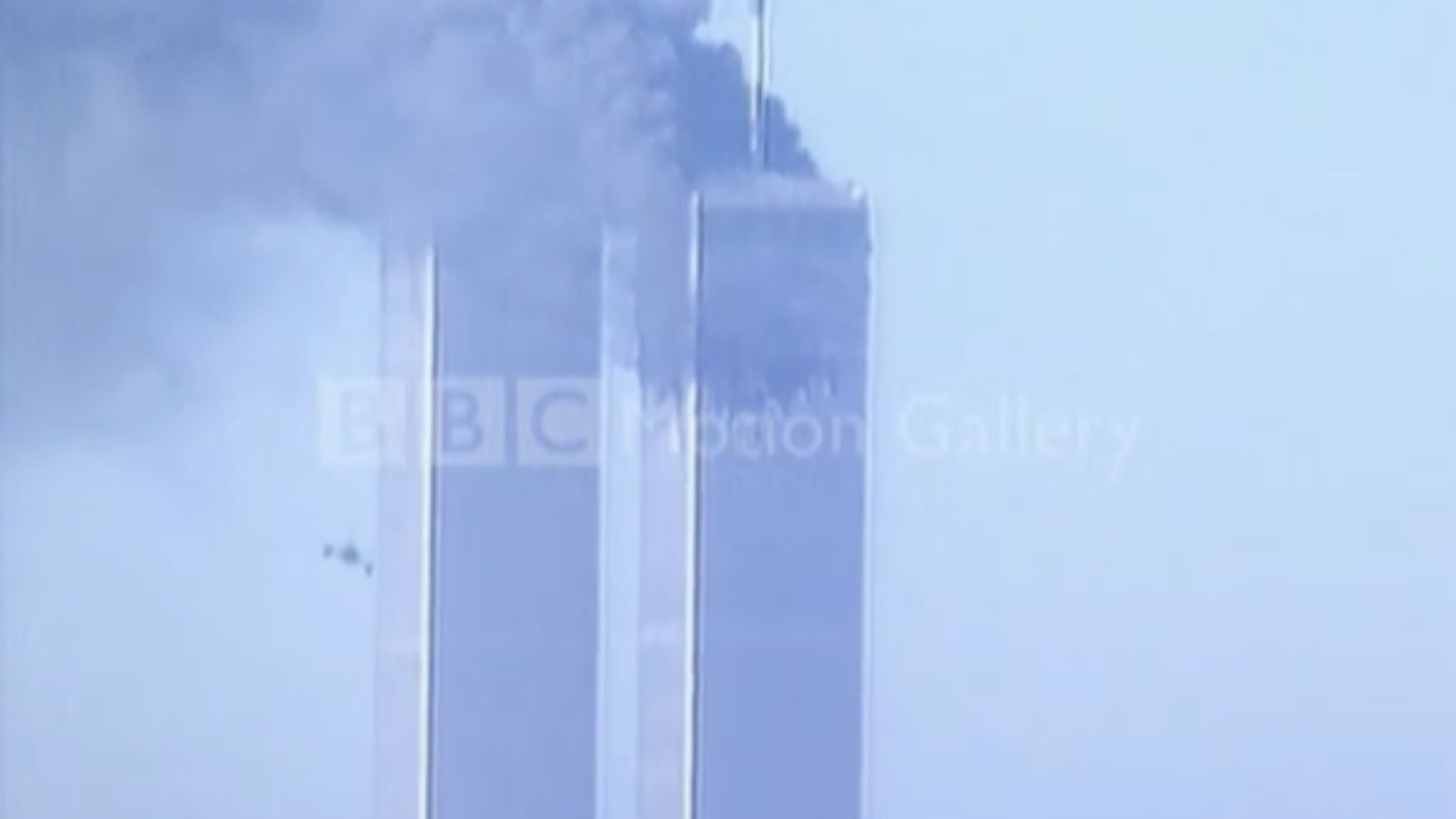
Video footage depicts United Airlines Flight 175 (UA 175) impacting World Trade Center tower 2 (WTC 2) on September 11, 2001 in New York City via a trajectory comprised of two separate banked turns. The second turn was apparently not required to generate impact. The first turn, which maintains a constant angle of bank (AoB), is evident at 1.2 miles before impact.1 Although human control of UA 175’s observed maneuvers cannot be ruled out, the precise coordination of variables such as the selections of a correct bank angle and turn start time for the first turn apparently pose challenges to the unaided human control hypothesis. The observed turn stability favors the use of autopilot operation, either functioning in a conventional course control mode or in Control Wheel Steering (CWS) mode. The probability that either of these two control systems were used is discussed. Flight deck images of United and American airlines 757s and 767s suggest that such CWS functions may have been disabled circa 2001. Constant radius turns utilizing plotted waypoints during commercial aviation operations are routinely supported by augmented GPS navigation service and related commercial Flight Management Systems (FMS) available circa 2001.2 As will be demonstrated, the implementation of UA 175’s observed 1.2 mile constant radius arc, seconds earlier or later than observed, would apparently result in UA 175 missing WTC 2. Estimates of the likely effect of crosswinds on the approach to WTC 2 are also provided. It is noted that a projected impact via the first observed banked turn would have occurred under crosswind conditions capable of generating approximately 120 feet of lateral displacement from the calculated final position of the aircraft if not properly accounted for. Aircraft distances and other calculations are based on reported aircraft speed for UA 175 of 799 feet per second at impact and measured times to impact 3. The observed speeds of both attack aircraft were extreme by comparison to the typical speeds of similarly descending aircraft. While creating significantly less response time for possible human hijacker pilot course corrections during final target approaches that would demand superior control surface operation, a general vector analysis considering the final course and speed for each aircraft suggests that the unusually high speeds observed would generate greater accuracy of the aircraft while enroute to their targets, as a result of smaller course deflection angles and ground track displacements, created by existing and potential crosswinds.
Keywords
Bank Angle, Constant Radius Turn, Vector, Ground Track, Radius-to-Fix Turn, Autopilot, Control Wheel Steering
About the Author
Aidan Monoghan is an electrical engineer and 9/11 researcher. His book Declassifying 9/11: A Between the Lines and Behind the Scenes Look at the September 11 Attacks (2012) connects dots related to the crimes of September 11th, 2001 by way of Freedom of Information responses.