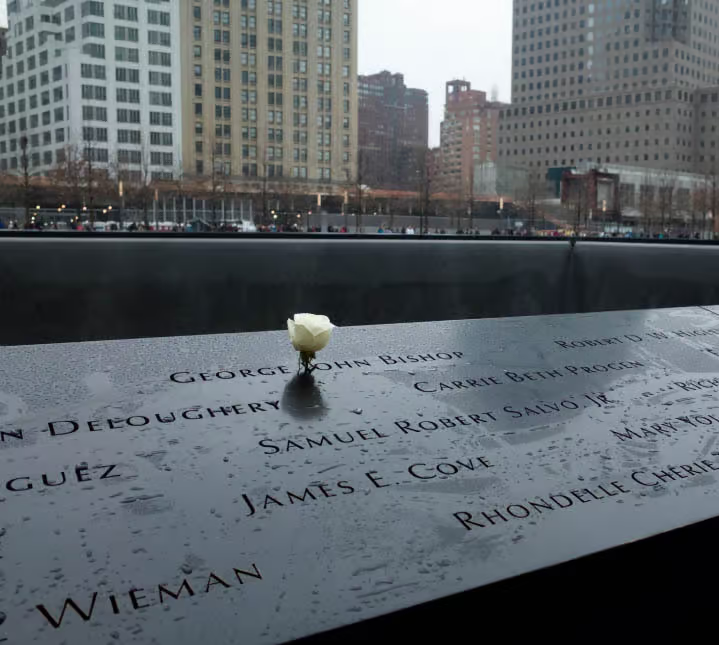
In his opening remarks at a conference on contemporary political history organized by the Miller Center of Public Affairs at the University of Virginia, future 9/11 Commission Executive Director Philip Zelikow emphasizes that the public understanding of history is shaped by what are sometimes referred to as “public myths.” “[U]nderstanding contemporary political history is extremely important and constantly alive in public discourse. ‘Contemporary’ is defined functionally by those critical people and events that go into forming the public’s presumptions about its immediate past. This idea of ‘public presumption’ is akin to William McNeill’s notion of ‘public myth’ but without the negative implication sometimes invoked by the word ‘myth.’ Such presumptions are beliefs (1) thought to be true (although not necessarily known to be true with certainty), and (2) shared in common within the relevant political community. The sources for such presumptions are both personal (from direct experience) and vicarious (from books, movies, and myths).” Zelikow says that public assumptions often grow out of “searing events”: “particularly ‘searing’ or ‘molding’ events take on ‘transcendent’ importance and, therefore, retain their power even as the experiencing generation passes from the scene.” [Zelikow, 1999  ] In a previous publication, Zelikow had written about how a “catastrophic terrorism” event could constitute a momentous, history-shaping milestone: “An act of catastrophic terrorism that killed thousands or tens of thousands of people… would be a watershed event in America’s history.… Like Pearl Harbor, such an event would divide our past and future into a ‘before’ and ‘after’” (see November 1997-August 1998).
October 21, 1998: Presidential Directive Updates Continuity of Government Plan to Deal with Terrorist Threat
President Clinton issues Presidential Decision Directive 67 (PDD-67), which updates the US Continuity of Government (COG) program in line with the emerging threat posed by terrorists. [Clarke, 2004, pp. 166-167 and 170; Washington Post, 6/4/2006] PDD-67, “Enduring Constitutional Government and Continuity of Government Operations,” requires agencies to plan for governmental continuity if the US is hit by a major terrorist attack. [Knight Ridder, 11/17/1999; Federation of American Scientists, 12/12/2000] The directive is classified and there is no White House fact sheet summarizing its contents. [Federation of American Scientists, 12/12/2000; US Congress. House. Committee on Government Reform, 4/22/2004] But according to Energy Department documents, the new COG plan “could be triggered by an event worse than what’s expected from the Y2K problem and comparable to the 1995 Oklahoma City bombing.” [Knight Ridder, 11/17/1999] According to the Washington Post, the result of PDD-67 will be that “every single government department and agency [is] directed to see to it that they could resume critical functions within 12 hours of a warning, and keep their operations running at emergency facilities for up to 30 days.” [Washington Post, 6/4/2006] The directive puts the Federal Emergency Management Agency (FEMA)—which is responsible for planning for and responding to disasters—in charge of the COG program. [US Congress. House. Committee on Government Reform, 4/28/2005, pp. 4 ] Within FEMA, the Office of National Security Affairs will specifically be responsible for COG activities. [Larson and Peters, 2001, pp. 103] FEMA’s responsibilities will include providing guidance for agencies to develop their continuity plans (see July 26, 1999), and the coordination of interagency exercises. [US Congress. House. Committee on Government Reform, 4/28/2005, pp. 4 ] Richard Clarke, who has now been appointed counterterrorism “tsar” (see May 22, 1998), drafted PDD-67 earlier in the year (see Early 1998). [Clarke, 2004, pp. 166-167] The COG plan will be activated for the first time on the morning of 9/11 (see (Between 9:45 a.m. and 9:56 a.m.) September 11, 2001). [ABC News, 4/25/2004]
November 1, 1998-February 2001: 9/11 Hijacker Atta and Associates Are Monitored Some by US and Germany in Their Hamburg Apartment
Future 9/11 hijacker Mohamed Atta, al-Qaeda operatives Said Bahaji and Ramzi Bin al-Shibh, and others in the al-Qaeda Hamburg cell move into a four bedroom apartment at 54 Marienstrasse, in Hamburg, Germany, and some of them stay there until February 2001. Investigators will later believe this move marks the formation of the Hamburg al-Qaeda cell. [Los Angeles Times, 1/27/2002; New York Times, 9/10/2002] Up to six men at a time live at the apartment, including, at times, 9/11 hijacker Marwan Alshehhi and cell member Zakariya Essabar. Alshehhi moves out after the first month; it is unclear why. [New York Times, 9/15/2001] During the 28 months Atta’s name is on the apartment lease, 29 Middle Eastern or North African men register the apartment as their home address.
Surveillance of Bahaji – From the very beginning, the apartment is under surveillance by German intelligence, because of investigations into businessman Mamoun Darkazanli that connect to Bahaji. [Washington Post, 10/23/2001] The Germans also suspect connections between Bahaji and al-Qaeda operative Mohammed Haydar Zammar. [Los Angeles Times, 9/1/2002] Bahaji is directly monitored for at least part of 1998, but German officials will not disclose when the probe began or ends. This investigation is dropped for lack of evidence (see (Late 1998)). [Associated Press, 6/22/2002; Los Angeles Times, 9/1/2002] Bahaji moves out in July 1999 and gets married a few months later (see October 9, 1999). [Der Spiegel (Hamburg), 8/29/2011]
Surveillance of El Motassadeq – German intelligence monitors the apartment off and on for months, and wiretaps Mounir El Motassadeq, an associate of the apartment-mates who will later be convicted for assisting the 9/11 plot, but apparently it does not find any indication of suspicious activity (see August 29, 1998). [Chicago Tribune, 9/5/2002]
Surveillance of Zammar – Zammar, a talkative man who has trouble keeping secrets, does not live at the apartment, but he is a frequent visitor to the many late night meetings there. [Miller, Stone, and Mitchell, 2002, pp. 259-60; Los Angeles Times, 9/1/2002; Chicago Tribune, 9/5/2002] He even lives in the apartment for a time in February 1999 (see February 1999). Zammar is the focus of an investigation that began in 1997 and continues until early 2000 (see March 1997-Early 2000). Interest in monitoring him increases in late 1998 (see October 2, 1998).
Surveillance of Atta – The CIA also allegedly starts monitoring Atta in early 2000 while he is living at the apartment, and does not tell Germany of the surveillance (see January-May 2000). Atta leaves Germany to live in the US in June 2000 (see June 3, 2000).
No Direct German Surveillance of the Apartment? – Yet, even though people like Zammar who frequently phone and visit the apartment are monitored, German officials will later claim that the apartment itself is never bugged. An unnamed senior German security official will later say that some surveillance of associated people gives “the impression that the people living there were fanatical believers. At the BfV [Germany’s domestic intelligence agency], we had to decide whether to ask permission to place a wiretap on the line at 54 Marienstrasse itself. We discussed this every day.” But he will claim that they ultimately decide they will not be able to get legal permission for a wiretap because there is no evidence that the apartment’s occupants are breaking any laws. [Vanity Fair, 11/2004] This claim that the apartment was not directly monitored seems contradicted by reports that Bahaji was the target of a surveillance investigation when he was living in the Marienstrasse apartment in late 1998 (see (Late 1998)).
What Would More Surveillance Have Uncovered? – It will later be clear that investigators could have found evidence if they looked more thoroughly. For instance, one visitor will recall Atta and others discussing attacking the US. [Knight Ridder, 9/9/2002] 9/11 mastermind Khalid Shaikh Mohammed is in Hamburg several times in 1999 and comes to the apartment. However, although there is a $2 million reward for Mohammed since 1998, the US apparently fails to tell Germany what it knows about him (see 1999). [Newsweek, 9/4/2002; New York Times, 11/4/2002] 9/11 Hijacker Waleed Alshehri also apparently stays at the apartment “at times.” [Washington Post, 9/14/2001; Washington Post, 9/16/2001] Remarkably, shortly after 9/11, the German government will claim it knew little about the Hamburg al-Qaeda cell before 9/11, and nothing directed it towards the Marienstrasse apartment. [Daily Telegraph, 11/24/2001]
November 5, 1998-September 24, 2000: 9/11 Hijacker Al Suqami Frequently Travels around Middle East and Asia
On August 11, 1998, 9/11 hijacker Satam Al Suqami is issued a Saudi Arabian passport. [Federal Bureau of Investigation, 10/2001, pp. 29 ] This passport will allegedly be discovered in the wreckage of the 9/11 attacks in New York (see After 8:46 a.m. September 11, 2001), allowing investigators an unusually detailed glimpse into the movements of one of the hijackers. While a majority of the hijackers seem to have traveled little prior to coming to the US, Al Suqami travels widely:  November 5, 1998: He enters and departs Jordan, enters Syria. November 11, 1998: departs Syria; enters and departs Jordan. November 12, 1998: enters Saudi Arabia. February 19, 1999: enters Saudi Arabia. February 24, 1999: enters and departs Jordan; enters Syria. February 25, 1999: departs Saudi Arabia. March 7, 1999: departs Syria. March 8, 1999: enters Jordan. May 13, 1999: departs Bahrain. May 15, 1999: enters Saudi Arabia. January 18, 2000: enters United Arab Emirates (UAE). April 4, 2000: enters UAE. April 6, 2000: departs UAE. April 7, 2000: enters Egypt. April 18, 2000: departs Oman, enters UAE. July 11, 2000: departs Egypt. July 12, 2000: enters Malaysia. [Federal Bureau of Investigation, 10/2001, pp. 33, 37-39, 42, 59-62, 75 ]
On September 24, 2000, Al Suqami enters Turkey and stays there for most of the next six months (see September 24, 2000-April 1, 2001). Then he will travel to Malaysia again before finally flying to the US. The above records are obviously incomplete as there are sometimes records of him leaving a country without entering it or vice versa. His travels to Afghanistan and Pakistan are also not mentioned, as there was probably an effort to keep them out of his passport. In 2007, al-Qaeda leader Luai Sakra will claim that Al Suqami was not just another hijacker but led a group of the hijackers. The release of Al Suqami’s passport records in 2008 will help corroborate that claim. [London Times, 11/25/2007]
Late 1998: German Intelligence Knows All Key Names of Al-Qaeda Hamburg Cell Members by This Time
According to author Terry McDermott, by late 1998, German intelligence knows all the key names of the al-Qaeda Hamburg cell led by 9/11 hijacker Mohamed Atta and hijacker associate Ramzi bin al-Shibh. This is mostly due to the on-going surveillance of Mohammed Haydar Zammar and Mamoun Darkazanli (see March 1997-Early 2000, Late 1998 and December 1999). It is not clear if the group is seen as an al-Qaeda cell, or just a bunch of radical Islamists. One unnamed senior German intelligence official will say in November 2001, “We only knew them as radical Muslims. This is not a crime.” This person will add, “They might have had contact with followers of Osama bin Laden. This also is not a crime.” [McDermott, 2005, pp. 73, 279] It is unknown if Germany shares this intelligence with the US.
Late 1998-Early 2002: US Intelligence Maps Al-Qaeda Network Using Phone Records; Many Attacks Thwarted
Beginning in the autumn of 1998, the FBI uses the phone records of an al-Qaeda communications hub run by operative Ahmed al-Hada and his son Samir to build a map of al-Qaeda’s global organization. A map showing all the places in the world that have communicated with the hub is posted on the wall of the interagency counterterrorism I-49 squad in New York. The hub’s telephone number was uncovered during the East African embassy bombings investigation (see August 4-25, 1998 and Late August 1998). [Al Ahram, 2/21/2002; MSNBC, 7/21/2004; Wright, 2006, pp. 343; New Yorker, 7/10/2006 ] According to FBI agent and I-49 squad member Dan Coleman, al-Hada is “uncle of half the violent jihadists we knew in the country.” [Suskind, 2006, pp. 94] Several of his sons and sons-in-law are al-Qaeda operatives and some die fighting and training with radical Islamists; this is known to US intelligence before 9/11. Hijacker Khalid Almihdhar is also a son-in-law of al-Hada. [MSNBC, 2/14/2002; Fox News, 2/14/2002; Los Angeles Times, 12/21/2005] The number is monitored by the NSA and over the next three years it mines intelligence that helps authorities foil a series of plots, including planned attacks on the US Embassy in Paris and the US Consulate in Istanbul, along with an attempted airline hijacking in Africa. However, the hub also serves as a planning center for the 2000 attack on the USS Cole in Yemen, which is successful (see October 12, 2000). [US News and World Report, 3/15/2004] The CIA, as the primary organization for gathering foreign intelligence, has jurisdiction over conversations on the al-Hada phone. Helped by the NSA, it stakes out the house—tapping the phone, planting bugs, and taking satellite photographs of its visitors. However, the CIA apparently does not provide the FBI with all the relevant information it is obtaining about al-Qaeda’s plans. [Mirror, 6/9/2002; New Yorker, 7/10/2006 ] For example, the FBI is not informed that hijackers Khalid Almihdhar and Nawaf Alhazmi make calls to the communications hub from the US between spring 2000 and summer 2001 (see Spring-Summer 2000 and Mid-October 2000-Summer 2001). The FBI also asks the NSA to pass any calls between the communications hub and the US to the FBI, but the NSA does not do this either (see Late 1998). [Suskind, 2006, pp. 94]
Late 1998-August 10, 1999: Pakistani Air Force Pilot Temporarily Replaces Alshehhi as Atta’s Roommate
Hijacker Marwan Alshehhi moved to Bonn, Germany in 1996, and studied German there. He then lived in Hamburg for several months in 1998, and returned to Bonn after failing a language exam. Just as he leaves town, a Pakistani student named Atif bin Mansour arrives in Hamburg, and begins living and studying together with Mohamed Atta. Early in 1999, Mansour applies with Atta for a room to hold a new Islamic study group. Mansour is a pilot on leave from the Pakistani Air Force. As the Los Angeles Times puts it, “This in itself is intriguing—a Pakistani pilot? Investigators acknowledge they haven’t figured out Mansour’s role in the plot, if any.” On this day, Mansour’s brother, also in the Pakistani armed forces, is killed (along with 15 other officers) when his surveillance plane is shot down by India. Mansour returns home and was detained and stopped from returning to Germany. Soon afterwards, Alshehhi returns to Hamburg. According to Mansoor’s father, “Atif was detained because he had not sought permission from the authorities before returning home to attend his younger brother’s funeral.” Then he is set free with assistance from a relative and works on Pakistani air force base. Contacted on his mobile phone by a reporter, Mansour says, “I won’t be able to speak further on such a sensitive issue.” [Rediff, 7/17/2002; Los Angeles Times, 9/1/2002; Washington Post, 9/11/2002] In March 2001, Mohamed Atta applies together with a Pakistani Air Force pilot for a security job with Lufthansa Airlines (see February 15, 2001). This pilot is a member of the same Islamic study group as Mansour, but it’s not clear if this is Mansour and he did come back to or stay in Germany, or if Atta was associating with a second Pakistani Air Force pilot. [Roth, 2001, pp. 9f; Newsday, 1/24/2002] The FBI later notes that Alshehhi arrived “almost as a replacement” for Mansour. After 9/11, the FBI asks Pakistan if the flight lieutenant and squad leader Mansour can be found and questioned about any possible role he may have had in the 9/11 plot, but there’s no indication Pakistan as to whether has ever agreed to this request. [Rediff, 7/17/2002] In late 2002, the German Federal Bureau of Criminal Investigations will say that Mansour remains “a very interesting figure.” [Los Angeles Times, 9/1/2002]
December 1998-December 2000: Hijacker Associate Al-Bayoumi Stays in Contact with Saudi Consulate Official
After 9/11, the FBI will examine phone records and determine that hijacker associate Omar al-Bayoumi calls Saudi official Fahad al Thumairy many times between December 1998 and December 2000. Al-Bayoumi calls al Thumairy’s home number at least ten times, and al Thumairy calls al-Bayoumi much more often—at least 11 times in the month of December 2000 alone. At the time, al Thumairy is working at the Saudi consulate in Los Angeles, and is a well-known Islamic radical. For part of 2000 at least, al-Bayoumi is living at the Parkwood Apartments in San Diego at the same time as hijackers Nawaf Alhazmi and Khalid Almihdhar. Al Thumairy will later deny knowing al-Bayoumi, but al-Bayoumi will admit knowing al Thumairy. [9/11 Commission, 7/24/2004, pp. 514; Shenon, 2008, pp. 310-311]
December 1, 1998: Bin Laden Actively Planning Attacks Inside US
According to a US intelligence assessment, “[bin Laden] is actively planning against US targets and already may have positioned operatives for at least one operation.… Multiple reports indicate [he] is keenly interested in striking the US on its own soil… Al-Qaeda is recruiting operatives for attacks in the US but has not yet identified potential targets.” Later in the month, a classified document prepared by the CIA and signed by President Clinton states: “The intelligence community has strong indications that bin Laden intends to conduct or sponsor attacks inside the US.” [US Congress, 9/18/2002; Washington Post, 9/19/2002; US Congress, 7/24/2003 ; US Congress, 7/24/2003] This warning will be mentioned in the August 2001 memo given to President Bush entitled “Bin Laden Determined to Strike in US” (see August 6, 2001).
December 2-4, 1998: NORAD Runs an Exercise in Which Simulated Information Is Injected into Its Radar Systems
The North American Aerospace Defense Command (NORAD) conducts an exercise, called Vigilant Virgo 99-1, in which simulated missiles are injected into its radar systems, apparently similar to the way simulated information will be injected onto its radar screens for a training exercise on the morning of September 11, 2001. [US Department of Defense, 1/15/1999; Toronto Star, 12/9/2001; Arkin, 2005, pp. 546] In August 1998, Secretary of Defense William Cohen directed the commanders in chief who are responsible for the Department of Defense’s unified combatant commands to plan, carry out, and report on a series of simulated Year 2000 “operational evaluations.” [United States General Accounting Office, 6/1999, pp. 8 ; United States General Accounting Office, 11/1999, pp. 15 ] Vigilant Virgo is the first in a series of NORAD operational evaluations that are going to be held in response to this order. [US Department of Defense, 1/15/1999; United States General Accounting Office, 6/1999, pp. 2 ; Military Operations Research Society, 6/22/1999, pp. 193 ]
Exercise Tests NORAD’s Year 2000 Preparedness – The three-day exercise is intended to evaluate if NORAD’s systems are vulnerable to the Year 2000 (Y2K) computer problem, which would be caused by computers being unable to properly read dates at the start of the new millennium. [US Department of Defense, 1/15/1999; New York Times, 2/9/1999] It evaluates the capability of NORAD’s systems to track and forward information about missile and space air threats when the command’s clocks are rolled forward to January 1, 2000. [United States General Accounting Office, 6/1999, pp. 8-9 ] The exercise is a collaborative effort in which NORAD is supported by personnel, equipment, and facilities belonging to the US Space Command and the US Strategic Command. [US Department of Defense, 1/14/1999; US Department of Defense, 1/15/1999]
‘Missile Events’ Are Injected into NORAD’s Sensors – Vigilant Virgo focuses on the missile warning element of NORAD’s integrated tactical warning and attack assessment function. [United States General Accounting Office, 6/1999, pp. 11 ; Military Operations Research Society, 6/22/1999, pp. 193 ] It involves “well over 30 missile events” being “injected” into NORAD’s sensors, according to Lieutenant Colonel Warren Patterson, a member of the Joint Staff Year 2000 Task Force. These simulated events involve data that is injected “as though it [is] being sensed for the first time by a radar site,” Deputy Secretary of Defense John Hamre will later describe. Some of the simulations involve mass attacks, while others involve attacks by a single missile. [US Department of Defense, 1/15/1999] The Y2K preparedness of the entire ground radar array network is analyzed during the exercise. [Bulletin of the Atomic Scientists, 3/1999]
Exercise Finds No Vulnerabilities in NORAD’s Systems – Vigilant Virgo will be considered a success. The exercise will find that there is “no degradation in any of the systems, whether they were in the Year 2000 environment, the virtual Year 2000 environment, or whether they were in the real world, 1998 environment,” Patterson will say. “We are highly confident now, at this point, that CINC [commander in chief] NORAD can do his early warning mission,” he will conclude. [US Department of Defense, 1/15/1999]
Exercise on 9/11 Will Use Simulated Radar Information – NORAD is the military organization responsible for monitoring and defending North American airspace. [9/11 Commission, 7/24/2004, pp. 16; Department of National Defence, 7/25/2017] Personnel at its Northeast Air Defense Sector (NEADS), based in Rome, New York, will be responsible for coordinating the military’s response to the 9/11 hijackings. [Shenon, 2008, pp. 203] It will be conducting an exercise on the morning of September 11, 2001, which, like Vigilant Virgo, involves simulated information being injected onto its radar screens (see (9:00 a.m.) September 11, 2001, 9:34 a.m. September 11, 2001, and 10:12 a.m. September 11, 2001). [Toronto Star, 12/9/2001] NORAD will conduct a follow-on exercise to Vigilant Virgo from February 15 to February 28, 1999, called Amalgam Virgo 99-2, which will involve a comprehensive evaluation of its systems for aerospace control, air warning, missile warning, and space warning. [United States General Accounting Office, 6/1999, pp. 11 ; Arkin, 2005, pp. 253-254] Whether that exercise will involve simulated information being injected onto radar screens is unclear.