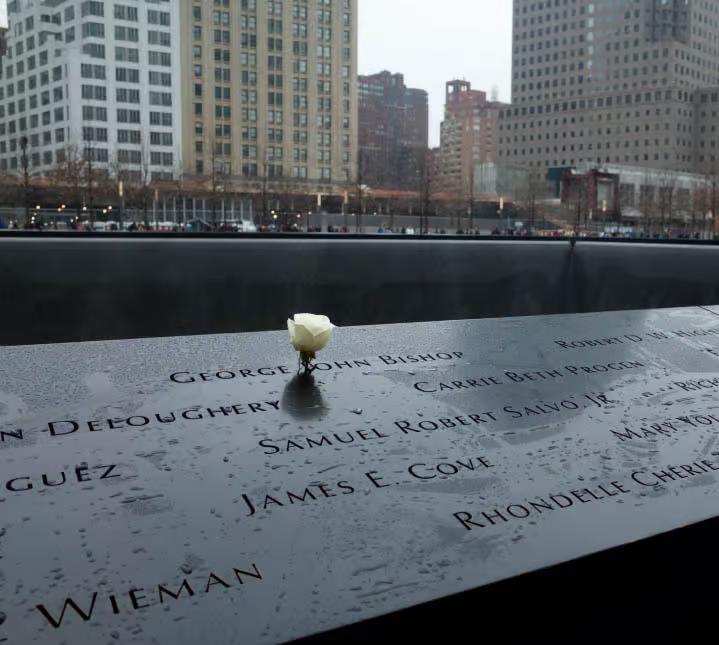
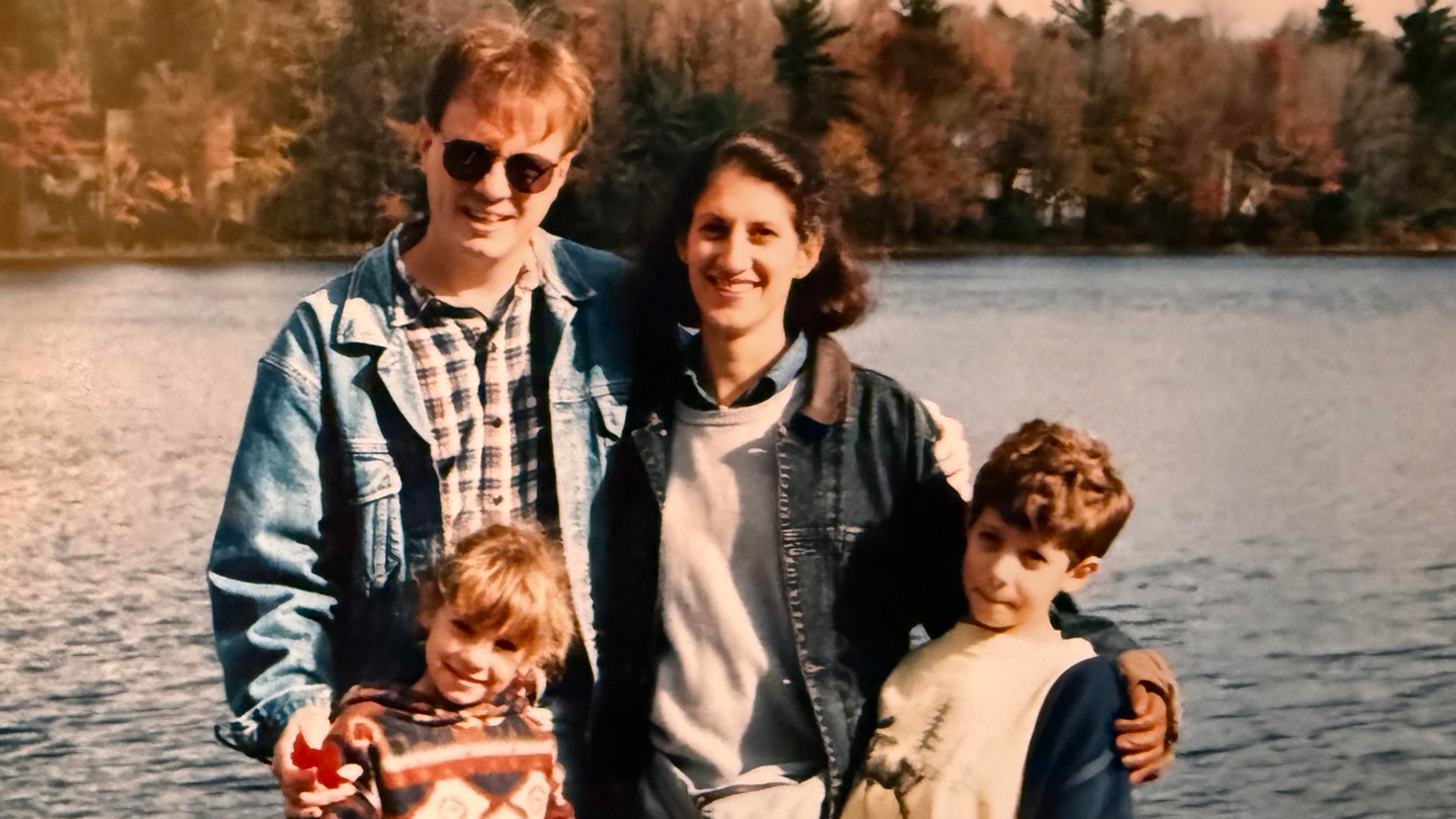
Lorie Van Auken was one of the four women coined “The Jersey Girls” — four widows whose husbands’ died on 9/11 and who lobbied lawmakers in the nation’s capital for an independent and transparent investigation into the events of September 11th.
She was one of a dozen members of the Family Steering Committee for the 9/11 Independent Commission. The FSC website featured their unanswered questions, their testimony, an archive of formal statements, and more. It is found at: https://www.911independentcommission.org.
In the aftermath of that tragic day, Lorie wrote an obituary for her husband, Kenneth Van Auken, on a website created by his employer, Cantor Fitzgerald, where Ken worked as a bond broker in mortgage securities on the 105th floor of the North Tower.
On September 11, 2001, the light went out in Ken Van Auken’s beautiful blue eyes. We lost his warm and wonderful smile forever, my children lost their Dad, and I lost my husband and closest friend. On November 1, 2001, Ken and I would have shared our 16th anniversary.
This summer, author Ray McGinnis was in conversation with Lorie Van Auken. Their dialogue led to Ray sending her questions asking her to reflect on the past quarter-century since the death of her husband.
Asking any family member who lost a loved one on September 11th to respond to questions on this subject is understandably sensitive. We are grateful to Lorie Van Auken for taking time to reflect on the following questions and for her responses.
Ray McGinnis (RM): Tell us about your husband, Kenneth Van Auken. What do you want readers to know about him as we approach the 25th anniversary of the events of September 11th?
Lorie Van Auken (LV): Ken had just turned 47 a week and a half before September 11, 2001. He was a strong and healthy man, with beautiful blue eyes and a smile that lit up a room when he walked into it. A mutual friend from college, where we met, referred to Ken as “the professional nice guy.” That’s who he was, always there to graciously lend a hand, a devoted husband, a great dad, and an all-round wonderful human being. The enormous impact that Ken’s death has had on our lives — our children were 12 and 14 when Ken was killed — can’t really be put into words. It’s very hard to believe that Ken was killed 25 years ago.
RM: In the aftermath of the devastation of the death of your husband — and the cost to your family — did you initially accept the emerging official account of what happened on 9/11?
LV: I had many questions immediately following the 9/11 attacks regarding the emerging official story, such as: How on earth did four planes get hijacked over the course of two hours with no military response even at the Pentagon? And why wasn’t the government launching their own investigation to find out how the United States could’ve been so vulnerable? Didn’t they want to patch the apparent holes in the security of the US? And why wasn’t anyone getting fired, since so many people died as a result of those fatal mistakes?
RM: Describe your reaction to the TV coverage of what was happening at the Twin Towers on September 11th?
LV: My reaction to the collapse of three WTC buildings from two plane strikes was, “What on earth are we being expected to believe?” And my reaction to the Pentagon getting hit was essentially, “You can’t be serious,” since the Pentagon is such an important and well-protected building.
RM: What did your husband’s computer room become for you after his death?
LV: Ken had built a computer room in our basement a couple of years before his death on 9/11. That room became my research center which I was unable to stay away from. I was drawn to it like a magnet on a daily basis. I had an image of only my feet sticking out of the computer, while the rest of my body was stuck in the computer screen. I was needing to dig through piles of files, night and day, desperately searching for clues as to what had gone wrong on 9/11.
RM: How did you find the other “Jersey Girls” — truth-seeking family members?
LV: Mindy [Kleinberg] and I had been introduced through a mutual friend, days after 9/11, since our friend knew that we were both widowed that day. We met Patty Casazza and Kristen Breitweiser at a meeting with some of our lawyers a couple of months later. We began discussing the events and realized that we had important questions that weren’t being asked or answered.
RM: Porter Goss hid behind his office door when you tried to speak to him. What can you tell us about this episode, and any other bizarre obstacles to your efforts to get answers to why your husbands died?
LV: A group of 9/11 family members gathered in Washington, DC, to try and drum up support for the establishment of the 9/11 Commission. We needed Congress’ help. Porter Goss was on the [House] Judiciary Committee, which was important for our mission. The group stopped in to see Congressman Porter Goss, but he clearly didn’t want to meet with us. His staff told us that he wasn’t in. His office had two doors. He hid behind one door, and tried to exit through the second door, but some of us could see him. We told him and his staff that we knew he was in because we could see him. And then we met with him.
RM: In the run-up to getting a 9/11 Commission established, Kristen Breitweiser testified on September 18, 2002, before the Joint Inquiry into Intelligence Community Activities before and after the Terrorist Attacks of September 11, 2001. What were some of the key points in her testimony, and what impact did this have on Capitol Hill?
[NOTE: The Joint Inquiry into Intelligence Community Activities before and after the Terrorist Attacks of September 11, 2001, was an unprecedented bicameral investigation launched by the Senate Select Committee on Intelligence and the House Permanent Select Committee on Intelligence.]
LV: Kristen testified before the Joint Intelligence Committee Inquiry (or JICI, as we called it) and strung together many of the outrageous intelligence failures that should have unraveled the plot and stopped 9/11 before it became the terrorist attack on U.S. soil that killed almost 3,000 people. She testified about Zacarias Moussaoui and his flight school lessons and how an FBI agent had sent a memo saying that Moussaoui could possibly fly a plane into the WTC, but the memo was ignored. She asked how the FBI knew exactly which flight schools to go to immediately after 9/11, wondering if they had been following these people prior to 9/11. She discussed specific threats using planes as weapons, in direct contradiction to Condoleeza Rice’s statement, “I don’t think anybody could have predicted that these people would take an airplane and slam it into the World Trade Center . . . that they would try and use an airplane as a missile — a hijacked airplane as a missile.” She looked into Al Hazmi and Al Mihdhar, and the support they received from possible Saudi agents upon arriving in San Diego, California, and the fact that they had been watch-listed because of their ties to the USS Cole bombing. From that experience we met Eleanor Hill, who was the Staff Director of the JICI, and we were encouraged by her to ask for a more thorough investigation, one that examined more than just the intelligence failures of 9/11.
RM: Dr. Henry Kissinger was appointed to head the 9/11 Commission. What conversation did September 11th families have with Dr. Kissinger that led to his resignation?
LV: Henry Kissinger had a reputation as someone who might be very good at conducting cover-ups. Many of us were wary of his appointment to head the Commission and asked to meet with him. We made our way to his New York City office, looked at the photos hanging on his walls and asked him some pointed questions. I wanted to know if he had any Saudi clients that might conflict with an investigation of the Saudis — and did he have any clients by the name of bin Laden? That seemed to take him by surprise, and he resigned the next day.
RM: Why did the families ask for the resignation of Dr. Philip Zelikow?
LV: We came to believe that Philip Zelikow was put on the Commission to act as a gatekeeper with major conflicts of interest. He had helped set up the National Security Council for President Bush’s 2001 transition and had written a book or two with Condi Rice. We learned that he was actively keeping some important information away from the commissioners. We also learned that he was treating some of the Commission staff badly, as they were trying to investigate the events of 9/11. We asked for his resignation and unfortunately were unsuccessful in that quest.
RM: What were some key takeaways from reading the 9/11 Commission Report?
LV: Key takeaways from the 9/11 Commission Report: It’s very difficult to summarize this, since this answer is really quite complex. For example, the collapse of World Trade Center 7 (the building that collapsed at 5:20 PM on 9/11, though it was not hit by a plane), was not mentioned in the final Commission Report. That was extremely upsetting. There was a lot of information missing, and a lot of our questions just never got answered.
RM: Various family members have referred to the 9/11 Commission as a “cover-up,” a “whitewash,” and “political theater.” How would you characterize the 9/11 Commission, looking back at this point?
LV: “Cover-up,” “whitewash” and “political theater” are very accurate characterizations of the 9/11 Commission.
RM: Did the release of 9/11: Press for Truth, and Kristen Breitweiser’s Wake-Up Call: The Political Education of a 9/11 Widow infuse new life into the quest for truth? What difference did they make?
LV: While 9/11: Press for Truth and Wake-Up Call brought some renewed attention to the lack of answers and to the need for an actual investigation into the events of 9/11, unfortunately that hasn’t come to pass.
RM: What were the obstacles to having a municipal (New York City) investigation into the events of September 11th?
LV: The obstacles to getting any new 9/11 investigation have seemingly been deliberately put out there. One can only surmise that there are things they want to totally keep hidden from public scrutiny. The obstacles to getting the 9/11 Commission in the first place were overwhelming, and it took us a very long time to get any investigation established. You would think that the government would’ve wanted to look into the 9/11 failures right away, but they didn’t have any interest in or intention of doing that.
RM: You’re aware that many arrested after September 11th and placed in Guantanamo remain there. Can you comment on the significance to you of the continuing detention of those charged who have yet to stand trial 25 years later?
LV: Guantanamo Bay (GTMO) is a giant black hole, and a permanent stain on America’s reputation. Twenty-five years in and the case still hasn’t even started. If you can believe it, they are still in the pretrial phase. You might even imagine that the government is hoping to put the trial off until all the inmates are deceased. As you know, justice delayed is justice denied, and that’s where we stand: without any justice.
RM: There are many questions on the Family Steering Committee website. The Family Steering Committee for the 9/11 Independent Commission brought questions to the commissioners to aid a proper investigation into what happened. What questions did they fail to address?
LV: A Google search as to what the 9/11 Commission was tasked to do reveals that although the 9/11 family members asked for an investigation into what happened on 9/11 in its entirety, somehow that got distorted into:
— The Scope of the Commission: The 9/11 Commission (https://9-11commission.gov/report) was tasked with investigating the facts and circumstances of the terrorist attacks, including preparedness, intelligence agency responses, and the immediate national security and emergency response.
— Focus on the Plot: The final report focuses heavily on Al-Qaeda, the hijackings, flight paths, intelligence failures, and the responses of the FAA and NORAD, rather than a structural or forensic investigation of the collapsed buildings.
Their scope was clearly different and not as comprehensive as ours.
RM: Is there any information that has come to light in the years following the 9/11 Commission — and the questions the Family Steering Committee put to the inquiry — that you view as significant that the general public is unaware of?
LV: The public is unaware of a lot of the facts regarding 9/11 such as “perpetrators’ passports” being found near the former site of the WTC buildings in New York City and at the Pentagon, having floated down from the hijacked, crashed planes. And how the WTC buildings collapsed at free-fall speed. And how no plane hit World Trade Center 7, yet it collapsed just like the other two WTC buildings. I don’t know if the general public still has interest in learning any of those facts. But do I notice that there are many more people who are paying attention now than there were at the beginning.
RM: Is there anything else you would like to tell us as the 25th anniversary of the events of September 11th approaches?
LV: I don’t really know what more to add on this 25th anniversary. A quarter-century has passed, and there has been no justice and no accountability. A third of the 9/11 families have not received any remains at all from our loved ones. They walked out the door on September 11, 2001, and were vaporized and ground into dust, along with the WTC buildings. The people who would have a say in having any of these anomalies uncovered just don’t seem to want them uncovered.
Ray McGinnis is the author of Unanswered Questions: What the September Eleventh Families Asked and the 9/11 Commission Ignored.