After five years of tireless effort, Matt Campbell finally had his day in the UK Supreme Court this week. And it may just prove to be the turning point that eventually leads him to the West London Coroner’s Court.
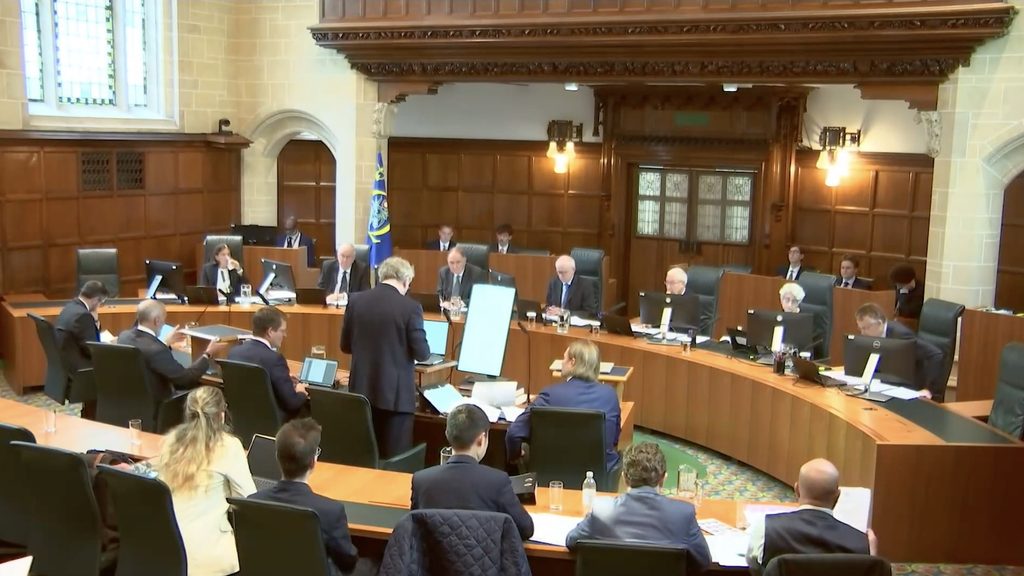
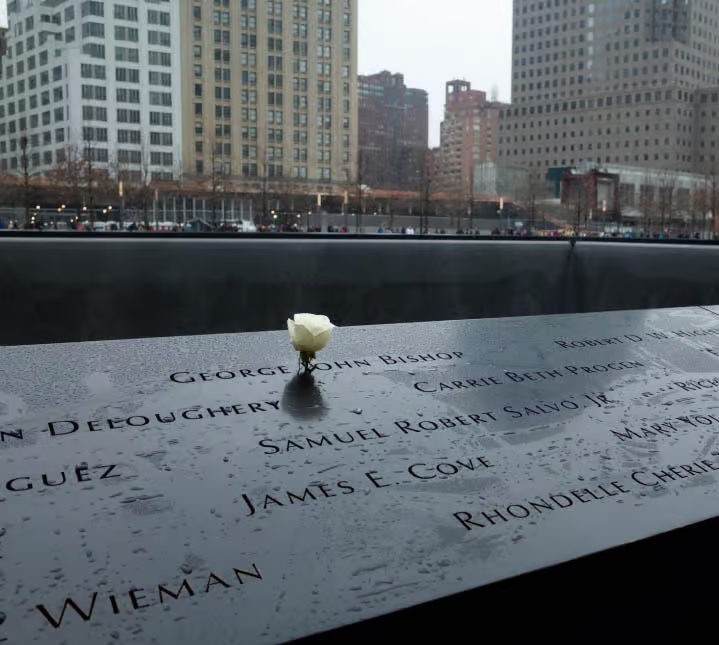
On October 14 and 15, seven justices of Britain’s highest court heard arguments in Matt’s appeal against the Attorney General for England and Wales. The two-day hearing marked a historic milestone in his family’s pursuit of a new inquest into the death of his brother Geoff, who was killed in the North Tower of the World Trade Center on September 11, 2001.
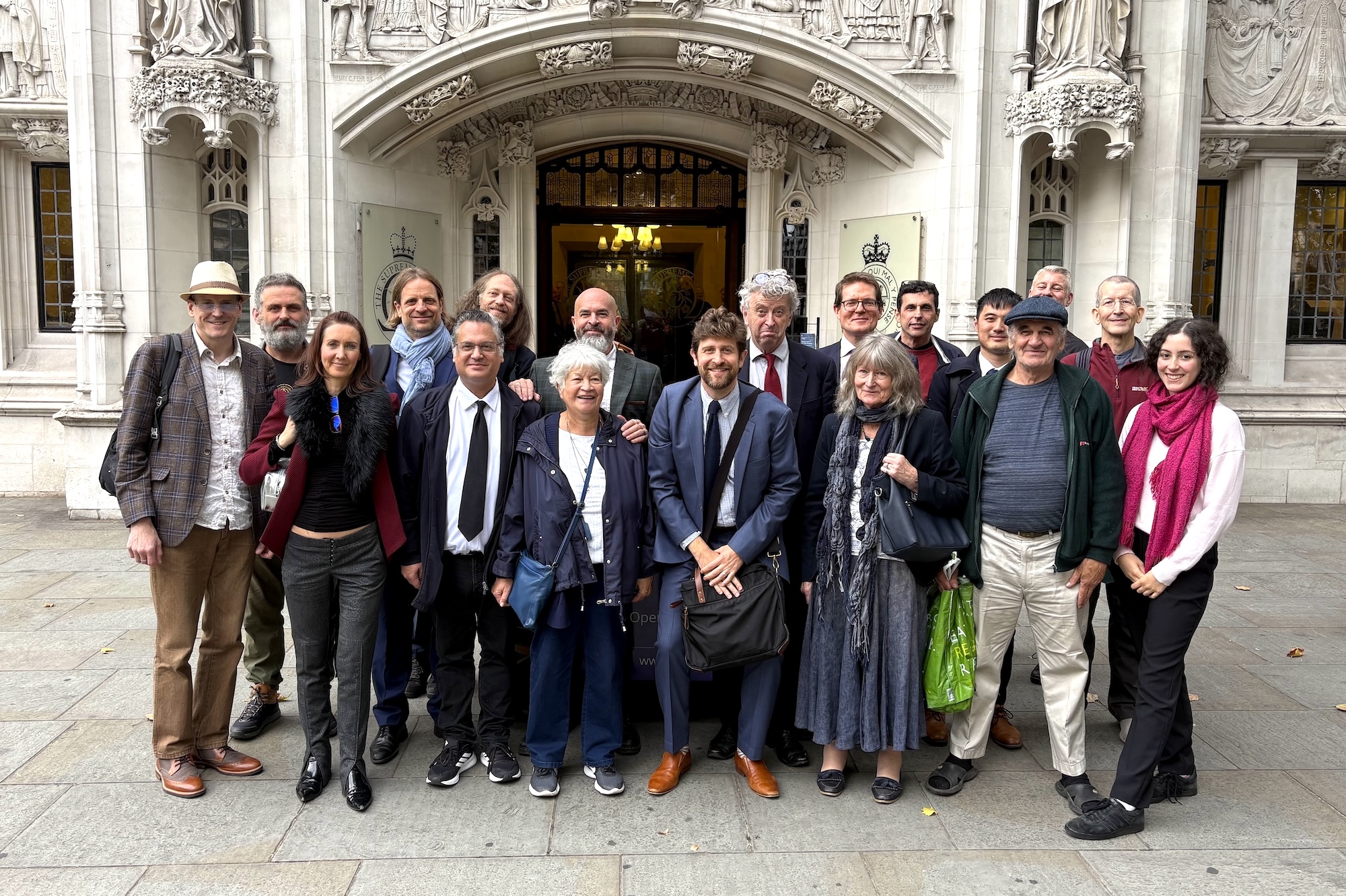
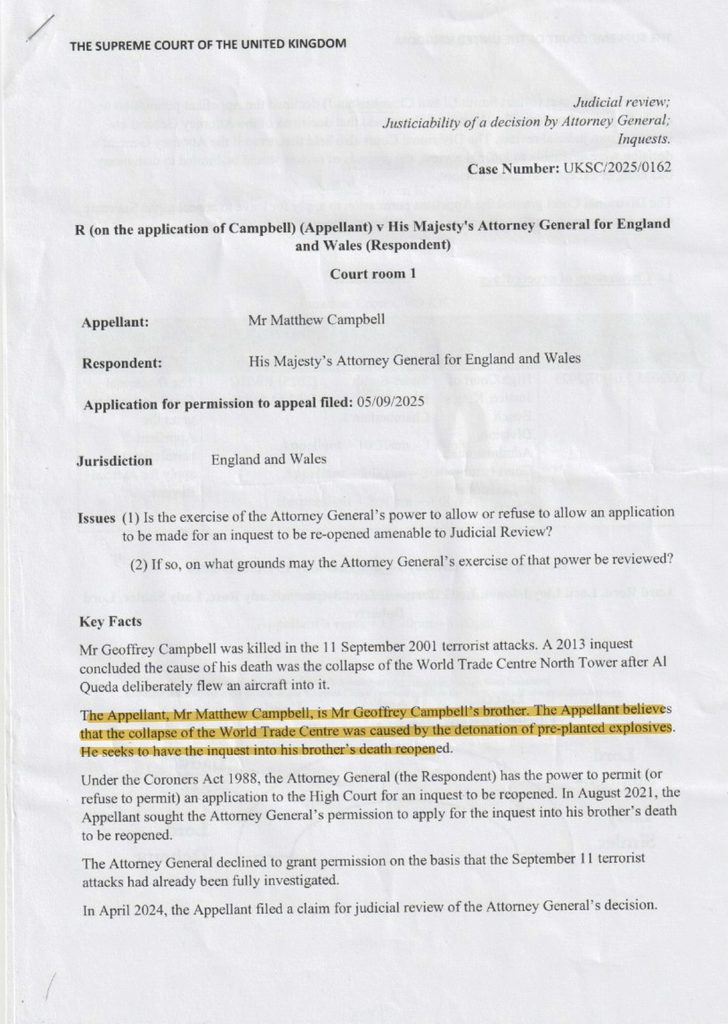
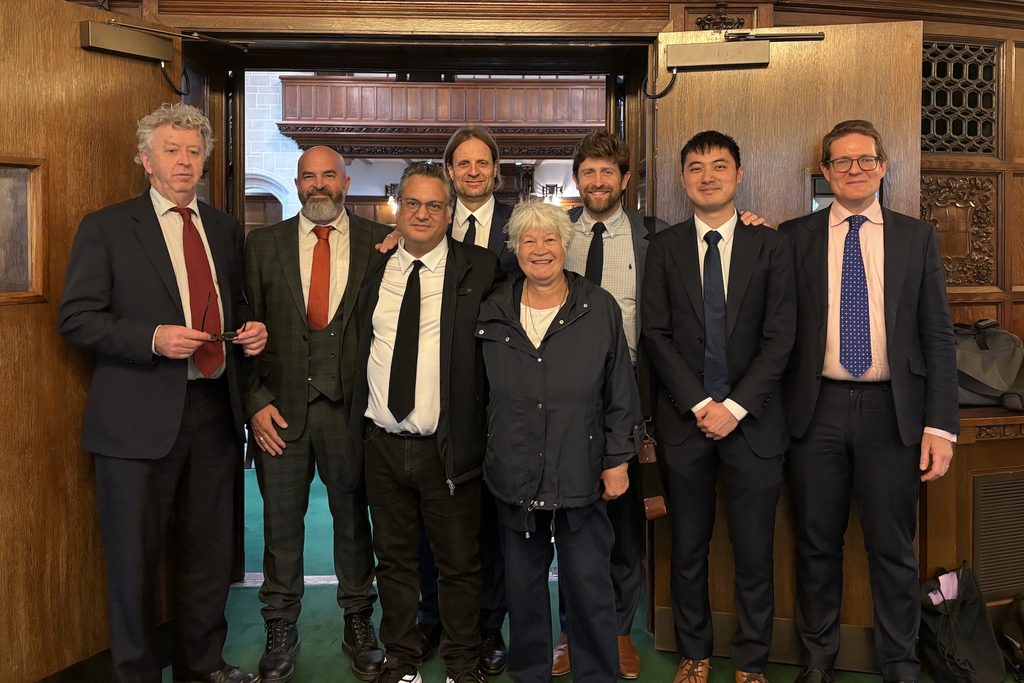
A few dozen of Matt’s supporters attended the hearing over the two days. Meanwhile, hundreds of members of the public who passed through the courtroom were handed summaries of the case, which plainly stated Matt’s contention that the Twin Towers were brought down with explosives.
The significance of this landmark hearing extends far beyond Matt’s case. The Supreme Court’s eventual ruling could establish foundational case law in Britain concerning the power of the courts to review decisions of the Attorney General.
The legal battle before the court
The central question before the Court was whether the Attorney General’s refusal to authorize the Campbell family to apply to the High Court (two levels below the Supreme Court) for a new inquest can be challenged through judicial review.
Matt’s legal team argued that the Attorney General should not enjoy blanket immunity from judicial scrutiny and that the 1978 precedent relied upon by the lower court concerned a fundamentally different legal function.
The Attorney General’s legal team argued that established precedent protects certain decisions from judicial review and that authorizing applications for new inquests involves broad public interest considerations — potentially including political and international factors — that are outside the courts’ purview. The government further argued that, even if judicial review were available, courts should exercise considerable restraint.
The Supreme Court will also consider written submissions from two intervening human rights organizations, REDRESS and the Global Legal Action Network, which argue that judicial oversight should extend broadly to many types of decisions made by the Attorney General and not merely to those concerning applications for fresh inquests.
The road ahead
The seven Supreme Court justices are expected to deliver their ruling within the next several months.
If Matt prevails, the case could return to the High Court, opening the way for judicial review of the Attorney General’s refusal. If that judicial review ultimately succeeds, Matt and his family would finally be able to apply to the same High Court for a new inquest. In that inquest, the evidence surrounding the destruction of the North Tower would finally be examined in a court of law.
The road ahead may still be long. But reaching the Supreme Court is itself an extraordinary achievement. Five years ago, the Campbell family began their quest for a real investigation into Geoff’s death. After having their path blocked by the very government that is meant to assist their pursuit of justice, their case has now been heard by the highest court in the land. The ruling that will come in the months ahead has the potential to reshape an important area of British law in favor of greater accountability while at the same time clearing the way for the new investigation the Campbell family is entitled to.
To everyone who has supported Matt — whether financially, morally, or otherwise — this milestone belongs to you, too.
Together, we have brought the Campbell family’s fight this far. And together, through Matt’s case and various other avenues, we will continue the pursuit of truth and justice until these goals are achieved.
Videos of the hearing along with all of the parties’ written cases can be found on the Supreme Court’s webpage for Matt’s case.