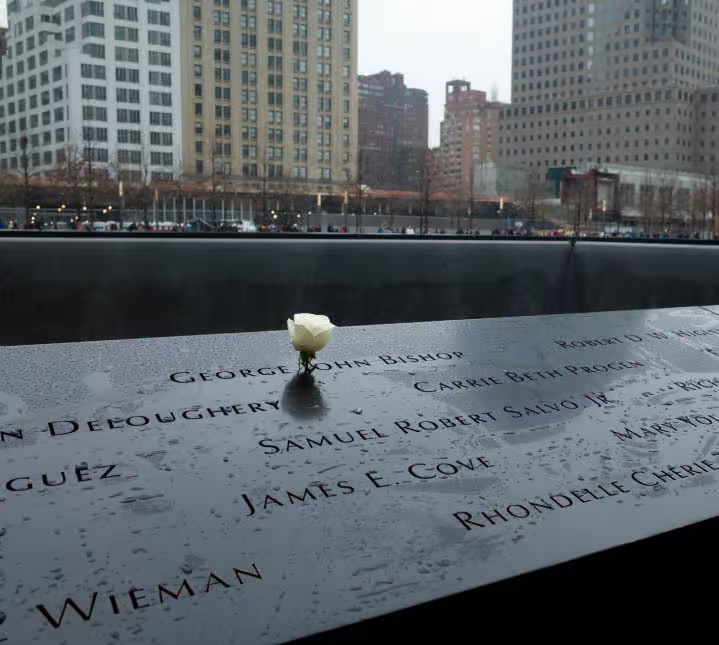
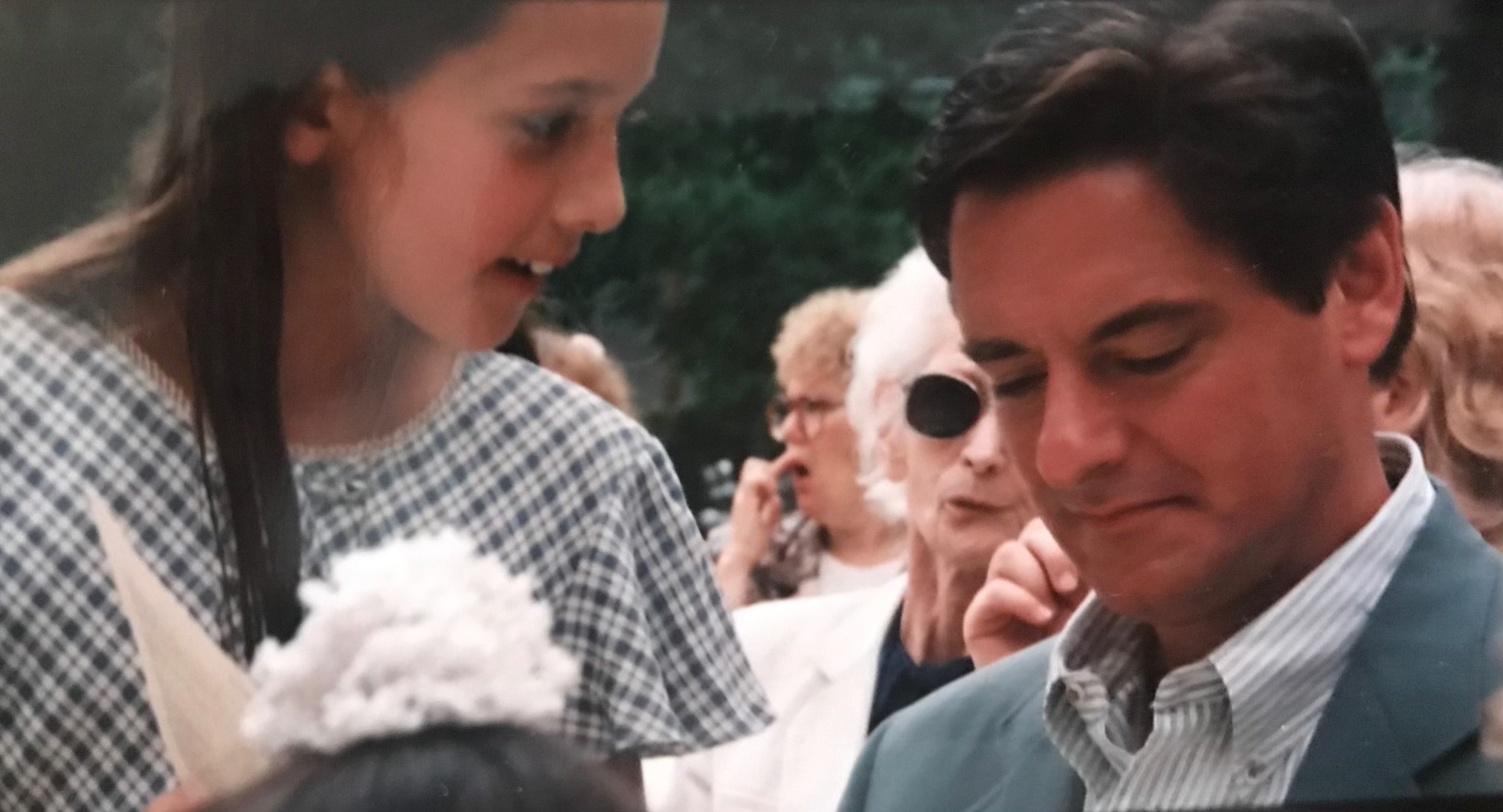
Earlier this year, Ray McGinnis interviewed Kacee Papa, one of four daughters of Edward “Eddie” Papa. Eddie Papa was born in 1954 and died at the age of 47 on September 11, 2001.
A longtime employee of Cantor Fitzgerald working in securities, Eddie Papa was in the North Tower in February 1993 during the truck bombing at the World Trade Center. On December 15, 2001, The New York Times tribute to Eddie Papa included these words: “His brother, the Rev. Charles E. Papa, said Mr. Papa was a deeply committed Roman Catholic who respected others’ beliefs. He also helped people, including the elderly woman he carried down 10 flights of smoke-filled stairs in the 1993 attack on the trade center” on February 26th that year.
Ray interviewed Kacee from her home in Vermont, a state Ray mentioned before the interview got underway that his own family has roots in going back to the 1780s.
KP: Hello, Ray.
RM: It’s good to be speaking with you. This interview is happening in advance of the 25th anniversary of September 11th. Your father died on that day. Please tell us about your dad, his name and who he was.
KP: His name was Eddie Papa. He was a father of four daughters. I have three older sisters. He married my mom when they were young. They met in high school. He was 47 when he died. He was beloved by many people. He was a family man, a good friend, father, son, uncle, brother. He was kind. I don’t remember him getting angry. He held a lot of our family together, and we still miss him deeply. He worked at Cantor Fitzgerald, on the 105th floor of the North Tower.
RM: Your dad was much loved in your family, well-respected, and admired as a friend and colleague with others who worked with him in that office.
KP: Yeah. He was good friends with all of his buddies at work. I knew some of them. They would do the Montauk triathlon. They spent a lot of time outside of work together, and he would always tell us about them.
RM: Wonderful. Did you ever go with your dad to his office?
KP: I did. I have a memory of a “take your daughter to work day.” I was probably, like, 10 or something. I remember walking into his building and feeling as though the towers were really tall and looking out of the windows and thinking, “Oh, my God, you’re so high up. You work here?”
RM: I remember being at a conference in the late ‘70s. I was taken by my hosts up to the Windows on the World on the 106th floor of the North Tower. In addition to the view, when visiting the restroom, there were all of these attendants opening the entrance, bathroom cubicles, turning on the taps, handing me a towel, with each one also wanting a tip.
KP: Of course. I remember that going on in Manhattan and Long Island growing up.
RM: So your dad was in the North Tower on September 11th. Tell me where were you when the towers were struck? What do you remember about that day?
KP: I was 16 years old, a junior in high school, and was at school. I was in Spanish class, and a woman from the office pulled me from the room and told me that a plane hit the World Trade Center. She told me to come sit in the office and that I can listen to the news on the radio. So, I stayed in the office for a while. Eventually, I went back to class. At some point, my uncle had come to the school to get me because all of the phone lines were tied up. You couldn’t call anybody, as everybody was trying to call everybody, and we were all trying to call my dad’s office, obviously. The phones weren’t working. So my uncle came to the school and got me and took me home to my mom.
RM: And you couldn’t reach your dad or anyone in the office?
KP: No. We were all trying, obviously. My sisters and my mom and I were all trying. And it was just a busy signal.
RM: And how long was it before you knew he was dead or understood he had died? Was there hope?
KP: We gave up after about a week or so. Soon after I got home, a lot of family and friends came to our house, my aunt and uncles. We were all calling hospitals in Manhattan, writing down everywhere that we’ve called, and searching. My uncles and my sister went into Manhattan. They put up missing person signs. There were no answers. We called that time “Groundhog’s Day” because every day we woke up and were doing the same thing: searching for my dad. After about a week, we had to face reality. Soon after that, we had a memorial for him.
RM: For some family members, authorities would bring them something, a ring on a finger or something else to confirm that their loved one had died. Did you ever have anything?
KP: Yes, that didn’t happen until about a year or two later, after they had gone through the rubble and they found a part of his jaw and arm bone.
RM: So, there’s one part of going through with the memorial for your father, but then this delay of having the absolute confirmation for over a year or more.
KP: Well, if my dad didn’t come home, he’s probably gone. It was just a lot of confusion, because we didn’t know where he was or what happened. And so, we were always hoping for something. At some point we had to give up hope.
RM: Yeah. And again, how old were you at that point?
KP: I was 16.
RM: You were 16. So, I’m guessing others were involved in being executors of the will and all of those kinds of details?
KP: Yeah, my older sister, who has since become a lawyer, took over a lot of those functional necessities. My sister and mother did the best they could to figure all that out.
RM: I was the executor when my dad died of cancer twelve years ago. I know how challenging it is just to attend to all of those details that with a will can extend months, even years, after someone had died. In the midst of arrangements for a memorial service, having things left to be attended to the will, were you initially accepting the official account of what had happened on September 11th?
KP: Yeah, I was 16, and a lot of my family believes the mainstream media. So, I wasn’t really offered or aware of other perspectives.
RM: So, faced with the growing iteration of details offered to bolster the official account, do you recall a time where you came across either a public event for 9/11 families in the area, or you read something or heard something that was off message?
KP: Yes. I saw the Michael Moore film, Fahrenheit 9/11, in the movie theater. I remember thinking, “Whoa, I haven’t heard about any of this.” I went home and was trying to talk about it with my mom. She said something like “Evil like that doesn’t exist,” and I took her word for it. I’ve since come to realize that evil counts on that way of thinking.
RM: Yes. There’s a calculation that’s made when something happens that’s over the top, that’s overwhelming, that scares people, the safest explanation that ensures people trust whoever’s in charge is the explanation that people want to run to. And it’s expounded by the media and government.
KP: I was still young. It wasn’t until about nine years ago that I had come across Architects & Engineers for 9/11 Truth. And that whole website blew me away.
RM: So, you discovered the Architects & Engineers for 9/11 Truth website in 2017?
KP: Yes.
RM: So, just one day in front of your computer, it just happened to go in a certain direction?
KP: No. My partner was reluctant in the beginning to talk to me about 9/11, but eventually he began to send me information or articles he had come across, and that’s what led me to the Architects & Engineers for 9/11 Truth.
RM: So, when you got on that website, what were some of the things that blew your mind?
KP: Pretty much all of their work. The articles, presentations, and documentaries that architects and other experts did. One being Stand for the Truth, where they interview a former NIST employee, Peter Ketcham. He breaks down the implausibilities of the NIST’s official account/explanations of what happened. Ted Walter, I think, would show footage of the NIST official stating there were no explosions that day. Then news coverage of eyewitness accounts are shown where you are able to hear many explosions ultimately juxtaposing the ridiculousness of what this NIST official is trying to say. It’s really hard to not see it once it’s explained to you. Like the steel beams. I could talk about many different things related to physics in general, you know, buildings don’t come down like that. I don’t know if you’ve looked at any of this information?
RM: Yes.
KP: They do a great job breaking it down. They have lectures upon lectures explaining how the towers falling in less than ten seconds is impossible. Also, World Trade Center 7. It’s just absolutely insane that most people don’t even know that that building fell that day. It’s overwhelming the amount of evidence that’s out there. There are so many different facets of that day. That’s just one of them. It’s impossible to ignore for me.
RM: Yes. There was a documentary called Seven, interviewing Leroy Hulsey, the engineering professor at the University of Alaska Fairbanks who was looking into World Trade Center 7.
KP: Yes. I think he spent almost a year or more on his study that disproved NIST. It is all very valid, insightful information that people should take seriously.
RM: So, it was sixteen years after the attacks in 2001 that you were beginning to watch documentaries and read articles on the Architects & Engineers for 9/11 Truth website. In the years after September 11th, did you become acquainted with any other family members in the following years — just to console each other or anything? Did you know other family members then or now?
KP: When I was away at college my sisters would go to gatherings for other children of 9/11 victims. But I never attended any. I know a few people who lost family members. Believe it or not, it’s not easy to talk about this with my family or anybody who loved my dad. It is such a loaded subject. And you were talking earlier about how the responses you would get, before you decided to write your book Unanswered Questions. I get the same sort of responses, yet this is a personal situation for me. And it’s nice to talk to you. You have awareness and understanding. But I don’t talk about this with mostly anyone.
RM: Yes. We had talked in a prior conversation before this interview about part of my motivation to write my book, Unanswered Questions: What the September 11th Families Asked and the 9/11 Commission Ignored, because I had questions. I could see the Family Steering Committee for the 9/11 Independent Commission had all these questions on their website that were still there to look at. But if I had ever brought up any questions I had about the official account, how I was skeptical of some of the official explanations, I would be told as a citizen here in Canada that asking the questions I was raising was being, quote, “disrespectful to the to the 9/11 families.” So, that was the position I was in as an ordinary citizen. It’s interesting to hear your own experience as someone who lost her father can’t raise this even with his colleagues or your family members.
KP: Yes, for the same reasons. People automatically think you’re a “conspiracy theorist.” Or it gets very emotional, even volatile. Not with family. But if I try to talk about it with people I don’t know, anger has been a response in a few instances. For myself, this is a very personal tragedy, and it is not easy to delve into all of it.
RM: Yeah. Sometimes, ahead of thinking of having a conversation with someone about a loaded topic, we can walk through — talking to an aunt, a sister or my dad’s friend — you try and walk through the scenario in your head. Think about making the phone call, or getting together for coffee, and then we’re going to maybe bring this up. And then.
KP: And then I get very nervous. I’ve talked about it a little with my family, and some have come around, are more open as of late. I get very sad and angry, to say the least, watching and reading about the evidence or politicians at the time being so flippant and complacent regarding the murders of so many innocent people. But I don’t want to be ignorant. I want to be aware of these realities, even if it’s hard.
I rewatched the documentaries Loose Change and the other one, Seven, you mentioned. And it’s just mind-blowing that they wouldn’t consider the families’ questions. It brings up so many different emotions, even though it was a long time ago. So, I think that it’s hard for people. Most just want to be okay and turn their head the other way.
RM: Yes, it gets down to a very personal decision, trying to raise something that’s really important with a family member or a close family friend. Beginning to see a reaction just in the first two minutes of trying to raise the conversation and thinking, “I don’t want to make this person cry.” These are the kind of things that then end up being part of the dynamic of trying to proceed with having a conversation.
KP: Exactly. People might feel it is disrespectful to those who have been lost, as you said. But it’s not. I don’t mean to say, “Do your homework.” But if people would just take the time to look into some of this stuff, it wouldn’t be such a stretch, some faraway thought to consider other explanations for what happened on September 11th.
RM: So, as you’re discovering these questions and all this information 16 years after 9/11 although it was in the news, it wasn’t always highly profiled, at least not in Canada. Were you aware of the 9/11 Commission itself?
KP: I wasn’t. I mean, again, I was 16, and I would have been 18 at the time of the inquiry. That time was a really hard time for my family. I might not remember a lot. Looking back, I can’t say I recall anything of it.
RM: For me in Canada, with the 9/11 Commission, I may have seen a headline somewhere that there was going to be a commission. I saw Condoleezza Rice on TV while was visiting friends in a small town outside of Vancouver. I arrived and I was invited into their living room for appetizers. Dinner was going to be ready in half an hour. So they plopped me down in front of the TV and there was Condoleezza Rice giving some of her testimony before the 9/11 Commission. And that was it. That was all that I knew about the 9/11 Commission from my vantage point up here in Canada. And I thought of myself as someone fairly well-connected to the news that was unfolding from week to week. And yet, there was very little Canadian coverage about the 9/11 Commission. A person in Canada would have to be paying very close attention to what was going on to really know that there was a Commission unfolding.
KP: Yes. Even looking back, the media puts out what they deem safe to be heard by the masses. There was only maybe thirty percent of the families’ questions that were answered. It just seemed to have been blown over. It also seems that the Commission would never have happened if it wasn’t for the Jersey Girls and other victims’ family members fighting for that. That’s absurd for a mass murder. You get more footage about certain things that are happening of much less consequence.
RM: Yes. So, all the people who were pressing for truth, the dozen people on the Family Steering Committee. Lorie Van Auken, Mindy Kleinberg, Patty Casazza, and Kristen Breitweiser of the Jersey Girls, plus Monica Gabrielle, who lost her husband, Richard, and Sally Regenhard, who lost her probationary firefighter son, Christian, and others that were trying to get answers. I remember watching the 9/11 Press for Truth documentary around 2007 about the families’ efforts. In the documentary there’s a still photo, while Mayor Rudy Giuliani was testifying, and in the photo Sally Regenhard is holding up a sign that said “LIES!” And I thought, “This is really great, and important.” And up here in Canada you’d never know any of these dynamics at the 9/11 Commission had ever gone on.
KP: I know. Obviously, the media has figured out what to show you and what not to show you. And how to successfully program the masses.
RM: Did you ever happen to read, or glance at, the 9/11 Commission Report?
KP: I’ve read some of it, but no, I haven’t read the whole thing.
RM: The Family Steering Committee that was monitoring the 9/11 Commission, in the 9/11 Press For Truth documentary, described the report as a whitewash and a cover-up. That’s what they told the press.
KP: Yeah, it seems like it was to me. You know, they don’t even address (WTC) Building Seven. It seems like there’s a lot of information put out about it, and then it changes. And then it changes again. So, it’s hard to get any sort of factual timeline. I think it was the Loose Change documentary that showed that man that took all the news articles and put them all together. He was addressing Congress, highlighting everything that the government reported as the days, years went on after 9/11 versus the Commission Report — showing how a lot of information didn’t line up. So, it sounds like that’s a lot of what the 9/11 Commission did was just throw information out to make it seem like they have something to say. And it just makes people confused, personally, is what I get from the 9/11 Commission.
RM: Yes, Paul Thompson was also featured in 9/11 Press For Truth on the original Complete 9/11 Timeline. He had his timeline up on a website. Plus, there was a book later, The Terror Timeline. And he’s saying if you look at all the information, you end up raising a lot of questions that are really painful and people just don’t want to go there.
KP: That’s correct.
RM: You mentioned the thirty percent of the families’ questions. Seventy percent of the questions the Family Steering Committee found were not addressed at all. Another twenty-one percent were touched on. An example of how they were touched on was during the testimony of Secretary of Defense Donald Rumsfeld. He was asked, “Did you scramble planes to defend the Pentagon?” So, he was asked a question. But then he looked at the walls and the ceiling fixtures and the drapes and repeated the question back: “Did I scramble planes to defend the Pentagon?” Then 9/11 Commission Co-Chairman Thomas Kean slammed the gavel and said, “Time’s up. Next question.” So, technically, you could say that the question was asked, but there wasn’t much of an answer. And then there’s just nine percent of the questions that were actually answered in more detail. But it’s shocking.
KP: It’s a disgrace. And it only leads one to wonder: Why? It is clear, even more so today, that there seems to be a large network of malevolent people pulling strings. Like I said, it brings up anger. Just even watching George Bush in the press conferences post-9/11. It’s heartbreaking.
RM: So, you watch George Bush and it’s heartbreaking, aggravating, and confounding. And yet there are other people, maybe your own extended family and friends, and the general public, who will watch George Bush and seemingly feel reassured, at ease or at peace with the story he’s telling them on TV. Can you comment on what’s going on in society when some people like you are seeing something and then other people are seeing something totally different?
KP: I think it’s the story that the media weaves, right? This came up for me recently with somebody. A woman said something like, “After 9/11, we all came together and there was a lot of solidarity, and we got the bad guys, and the United States came together in a way never before.” And I thought to myself, “Huh? We got the bad guys?” It was a story that was sold. This was a false flag operation to continue war and more murder. The morning of 9/11, they put up Osama bin Laden’s image in the news and said, “That’s who did it.” How did they know that? But it seems like the fairy tale story, and all people want to remember is something like I just explained that you know: “We all came together after such a tragedy.”
RM: There are people like Senator Ron Johnson from Wisconsin and former Congressman Curt Weldon and other people in the broad 9/11 truth movement who are pressing for a new investigation. Would you support that?
KP: Of course. I think there’s millions of questions that people have. Depending on who you’re talking to, I think this topic is pretty well-known, as there is a growing skepticism of our government. Just the fact that RFK Jr. said something about it. Also with younger generations who may be more open and less emotionally attached to 9/11. If people were murdered in other situations and the families still had valid questions and evidence, they would oftentimes be honored and have an investigation. Why are we being disregarded? This is a very personal experience for us and there’s so much evidence. It’s overwhelming. Why are the powers that be pushing against any sort of legitimate questioning?
RM: What are several of the questions that you’d like to be asked in a proper, transparent investigation?
KP: I have a hard time regurgitating all the information I have in my head. I would want the clear evidence of controlled demolition to be looked at. One can see the steel beams flying — hundreds of pounds of steel beams — flying horizontally. That’s not how gravity works. Let’s take a look at World Trade Center 7, the University of Fairbanks study. Let’s take a look at the eyewitness news footage that has hundreds and hundreds of eyewitnesses saying the word “explosion.”
You can hear explosions on the footage. Victim family members did an autopsy on a victim’s body and proved that he died from an explosion before the building fell. Why are there so many bodies that weren’t found? Why did we only find a piece of my dad’s arm bone rather than his body? According to physics, buildings don’t fall that way unless it is a controlled demolition with explosives. A plane hits each building and it is blown out, floor by floor, into dust or out onto neighboring buildings.
Take a look at the molten steel that they found at the bottom of the Twin Towers. Why was there seismographic data reflecting activity recorded right before the towers fell that morning? Why was not one mechanical engineering safety standard for buildings changed or edited after such a catastrophic failure? Why was the cleanup so quick? Who paid for the cleanup? It’s a crime scene. Why was there no proper investigation? Information has come out recently about the hijackers and their connections to our government. Look at the Tucker Carlson series. There are still millions of questions people are piecing together since day one. I know some people might not feel it’s relevant anymore, because they’re living their quiet lives. But we’re still being affected in that those who are responsible for this atrocity continue to carry on in subliminal ways.
RM: Yes, the questions are important. They were never addressed. And when you’re given false assurances or fairy tale stories, or given answers that can’t be true, it’s really hard to come to peace with what happened, with why your father died.
KP: It’s true. Ultimately, my belief is that this will all come to light at some point, as light is stronger than dark. I don’t know when or how. I think my dad’s death will come to mean something more important for our future. Of course, I want to know the answers, but intuitively I already know what has happened. People will reap what they sow.
RM: Somebody said to me it’s easier to say what didn’t happen than what did. That the buildings didn’t fall because a plane hit them, or from office fires. But they fell because controlled demolition bombs were planted.
KP: You can just see it. You can hear the explosions on eyewitness accounts. There is also a documentary about the Twin Towers going up, and they discussed how they were built specifically to withstand a plane going into them. We can’t say all of this information doesn’t matter. These were the first documented high-rise buildings that fell into their own footprint ever. In nine seconds from a fire? It’s not believable. It’s impossible. There is footage and evidence of many people who knew this was going to occur before it did. Larry Silverstein, owner of the World Trade Center, is recorded telling FDNY to “pull” WTC 7 before it fell. Why did he say that? You can’t just demolish a building without planned, arduous set-up of explosives. How did news outlets know and report that the World Trade 7 tower was going to fall before it did? Why did Silverstein change the insurance policy of the towers right before 9/11? A lot of very sketchy, high-scale criminal behavior is going on and nobody’s being held accountable for their actions or their words.
RM: You sound to me like somebody who possesses common sense and who has the courage and curiosity to be skeptical of information when it doesn’t line up with your common sense and inner wisdom.
KP: Of course. That’s a quality that everybody should be working on.
RM: Yes. Yet it seems to me, twenty-five years after the attacks that not everyone’s working on these qualities.
KP: They don’t see it as a problem today. They think, “That was a problem twenty-five years ago. Why are you still worrying about it?”
RM: So, I’m interested in the story of how you cultivated your own common sense and skepticism in your life. Was it was the case that when you were in grade six everybody else in your class was full of common sense and skepticism? Or maybe you were one of the few people in the classroom who was asking questions other children didn’t think to ask? What’s been your story regarding just your expression of skepticism and common sense in your life?
KP: I think that I had a major awakening after I finished college and I went to nursing school and had my first real job as a nurse. I got super run-down because I was working full-time, taking calls, doing overnights. At that time, I thought “I did everything right. I did well in college. I have a job.” You know, this is what everybody’s telling me to do my whole life. And when I got there, I was so unhappy and drained. I realized maybe what everybody is telling me isn’t actually good for me.
I went into nursing to help people and learn about health and how to be healthy. In hospitals, no one is treating the causes or addressing the reasons for a lot of medical issues. Rather, it is more about damage control. The medical industry gives medication and performs surgery because that is financially fruitful. I thought I was going to learn how to take care of myself and my family, and when I got there I became disillusioned. So, I began to turn more to myself and my own inner guidance. I do my own reading and research and I try to be quiet and let information come to me. And I think learning about the reality of 9/11 is also a real big disillusionment. I realized I need to find my own way. And throughout that process, by trusting myself and my own intuition, I’ve had great, great results. So, I go with that.
RM: You’re reminding me of a poem by Robert Frost titled “The Road Not Taken.” It begins, “Two roads diverged in a yellow wood. . . . I took the one less travelled, and that has made all the difference.” It sounds like you’re one of those people on a road less traveled where not so many people are on that road with you.
KP: For sure.
RM: At this point, have you connected more recently with any other family members or any people connected to the 9/11 Truth Movement broadly?
KP: No. Ted Walter had connected me a while back with another family member who lost his mother who was about my age and involved with Architects & Engineers for 9/11 Truth at the time. And we emailed a little bit.
RM: So, it’s a bit more a journey of solitude and carrying this awareness, this knowledge. Many years ago I saw a tarot card with the hermit on it just simply holding a lantern in the night. There are flagstones in front of the hermit, and all the hermit is doing is holding the lantern so they can see the next step in front of them, trusting to keep on going, sensing the path ahead of them with each step. Not that you’re being a hermit. It seems like you’re on that kind of path.
KP: For sure. That’s part of the journey, to be with yourself, so you can then take on other aspects of the world.
RM: As this 25th anniversary approaches, is there anything that you want to say to the public?
KP: I think I’ve said a lot of it already throughout the interview. Having a new, unbiased, untainted investigation into September 11th is important, and I urge people to take a look at some of the information and evidence that has come out since that day. Be open. Because it can be hard for the victims’ families. I see that people don’t want to look into it. But know it’s even harder for the victims’ families to look at it. I have faith that a more benevolent world is coming and looking into this — and that may be one way to get there.
RM: Well, thank you very much for your time today. I really appreciate it. It’s an honor to speak with you.
KP: Cool. Thanks, Ray. Thank you for speaking with me.
RM: You’re welcome. Take care.
KP: All right, you too. Bye-bye.
Ray McGinnis is author of Unanswered Questions: What the September Eleventh Families Asked and the 9/11 Commission Ignored.