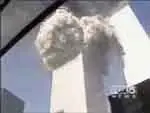
Jack Taliercio, cameraman. He and his fellow camera operators at WNYW FOX5 won an Emmy Award in 2003 for “coverage of an instant breaking news story.” The winning compilation they put together (he, David Corporon, and Keith Lane) was called “Capturing 9/11: Stories from Behind the Lens.” Clips of their footage are contained in the NIST Cumulus database, specifically files “WNYW Dub2 064” and 65-200 (many clips just seconds long, incomplete) — and from the NIST website “WTC Repository” as 500-WTCI-434-I.mp4 (at 26:00). UPDATE March 2012: Taliercio’s full tape (at least to run time 27:15 where Dave Corporon’s WTC2 collapse dust cloud footage begins – WTC1 collapse not captured) is available for download at wtcdata.nist.gov (after clicking Continue to agree to terms, it’s number 498-WTCI-433-I.mp4). Collapse at vrt 13:34. Thanks WTCFOIAVideos for uploading most of it on YT. See Jack interviewed at vrt 34:45 on the NIST site.
UPDATE Sept. 1, 2010: Newly available video of an explosion was shot by Taliercio. The video file in the recent FOIA NIST release is named “WNYW Dub1 35.” See 0:56 vrt, or this compilation of 3 views of the event. Here’s what the NIST WTC study said of the explosion in this clip:
The video shot from the WTC plaza captured an intriguing event at 9:37:04 a.m. A jet of air, dust, and a large piece of debris was ejected from a window, 77-355, on the 77th floor at an extremely high velocity. Longer distance videos show that puffs of smoke and or dust appeared simultaneously on the east face from several open windows near the center of the 78th floor and from open windows on the north side of the 79th floor.”
– Page 50/268 in NIST NCSTAR1-5A Ch 9 Appx C. Their theory of why it happened is on page 55/268, third paragraph:
“It is conceivable that the pressure pulse generated within WTC 2 at 9:37:04 a.m. could have resulted from the sudden collapse of the hanging object, presumed to be a portion of the 83rd floor slab, observed through open 82nd floor windows. While the rapid collapse of a large secion of a floor slab would likely generate a substantial pressure pulse, evidence supporting such a conclusion is circumstantial, at best. The actual collapse of the object was not observed, and there is no evidence that it occurred rapidly or even at this time. The appearance of large fires on the 82nd floor shortly after the pressure pulse is an indication that something happened on this floor around this time. On the other hand, most of the direct effects of the pressure pulse were observed on lower floors, particularly floors 77 through 79. The available pathways for transporting the pressure pulse are unknown, but it might have been expected that its largest effects would have been apparent near the floor where it was generated. It must be concluded that, while it is possible that the pressure pulse resulted from a partial collapse of the hanging object seen on the east side of the tower, the evidence is far from conclusive.” – NIST NCSTAR 1-5A Ch. 9 Appx. C, p.55/268.
Find some 9/11 video on the myfoxny.com website— including this demolition shot by Taliercio. This insane closeup is one of few angles to catch the dust jet, N side and center on the lower floors (See also non-TV amateur Alvarado). Another feature of the collapse highlighed by this angle is the symmetrical, timed nature of the tower’s destruction– before the supposedly crushing top portion had fallen that far. Taliercio runs for his life from the plume of extraordinarily dense dust. In the street he passes another cameraman (Dave Corporon, see National Geographic’s “Inside 9/11”) whose amazing footage of the expanding cloud was also seen on FOX5. “Look out behind you,” he says to the transfixed Corporon, running past. Both would survive. (As a matter of fact, the only journalist to perish would be Bill Biggart, photographer.) The WNYW camera was very close to televised amateur Evan Fairbanks.
Raw NIST Cumulus files: WNYW Dub1 53 and WPIX Dub5 26