Summary
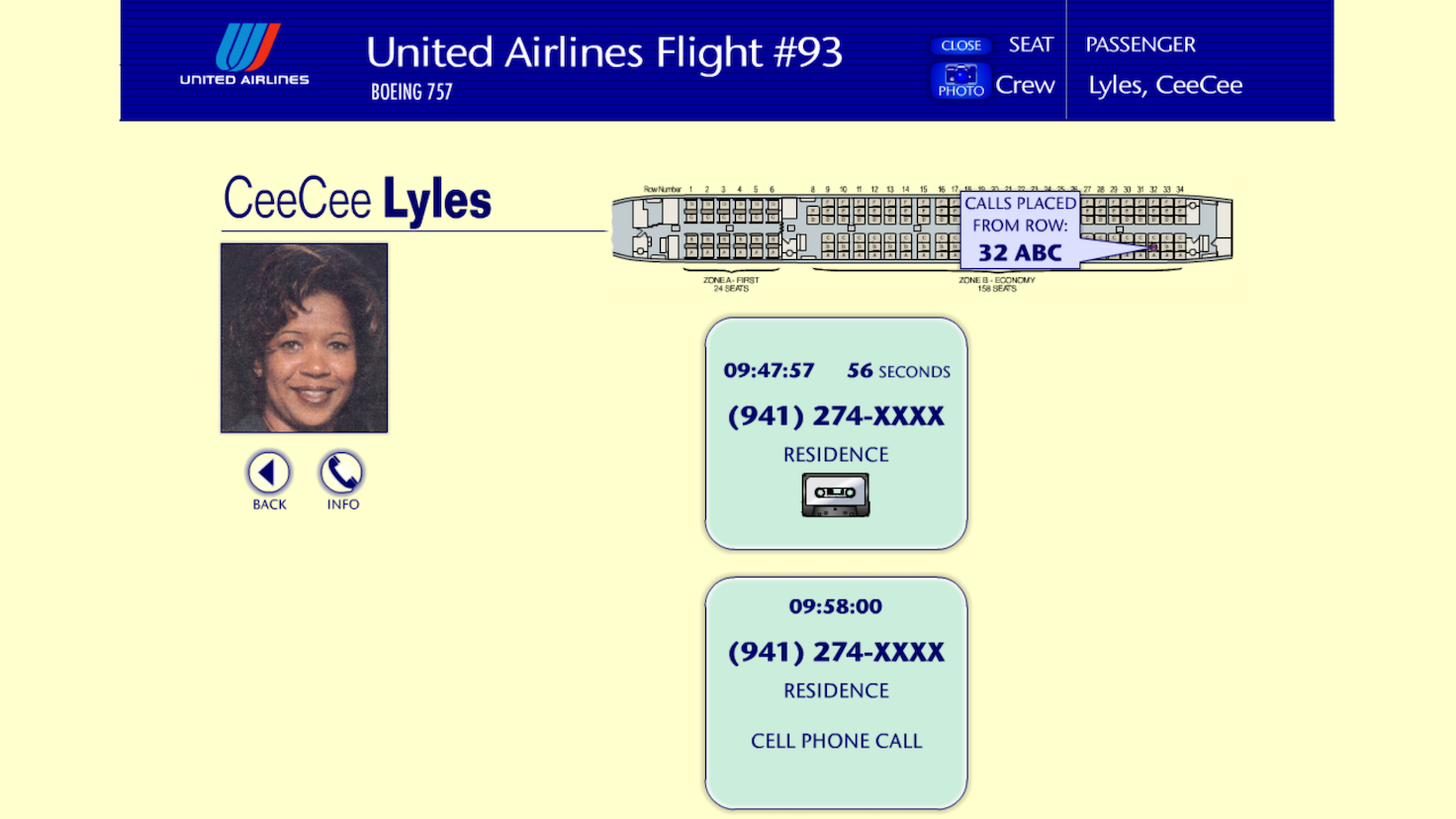
This addendum supplements Natalie Schilling’s April 2026 report by providing a more extensive forensic linguistic analysis of the whispered utterance heard at the end of the approximately 40-second voicemail left by United Airlines Flight 93 flight attendant CeeCee Lyles for her husband on September 11, 2001. The original report concluded that the utterance was acoustically more consistent with “It’s a frame” than the commonly suggested interpretation “You did great.”
Using auditory and acoustic phonetic analysis, including detailed comparison of spectrograms, the addendum considers several additional possible interpretations: “It’s a fake,” “It’s a shame,” and “He’s afraid.” Schilling examines the vowel formants and consonant patterns of these phrases, including differences associated with the “r” in “frame” and with the final consonants in “frame,” “fake,” and “afraid.” After comparing these alternatives with the recorded utterance, Schilling concludes that her original finding stands: “It’s a frame” is the most likely interpretation based on both auditory and acoustic analysis. In particular, the formant patterns of the first two words are more consistent with “It’s a” than with “He’s a” or “You did,” while the acoustic characteristics of the final word are more consistent with “frame” than with the other alternatives examined.
The addendum also considers the possible interpretations in their conversational context and finds that “It’s a frame” can be rendered contextually meaningful as an indication that someone or some entity was being set up to take responsibility for actions for which they were not responsible. Schilling emphasizes, however, that background noise, long-distance transmission, and whispering make definitive identification of the phrase difficult. She further cautions that the identity of the person who whispered the utterance cannot be determined with certainty.
About the Author
Natalie Schiling, Ph.D., is a Professor Emerita of Linguistics at Georgetown University, where she was a member of the faculty for 23 years and was tenured for 18 years.
As a Professor of Linguistics, she designed and taught a number of graduate and undergraduate courses focused on many areas of linguistic study, including General Linguistics (which includes phonetics and phonology, the study of language sounds), Sociolinguistics, Sociolinguistic Variation, American Dialects, Style and Stylistic Variation (variation within individuals), Sociolinguistic Research Methods, and Forensic Linguistics.
Throughout her scholarly and academic career, she has specialized in Sociolinguistics, the study of the interrelation between language and society. Within this, she has focused on the history, structure, meaning, and use of American English, with a particular interest in language variation and change across speaker groups (e.g. regional, ethnic, gender, and other social groups) and situations of use (stylistic variation), including pronunciation variation. She has also focused on forensic linguistics, the application of linguistic principles and analysis to legal matters.
She has authored, co-authored, or co-edited ten books, 47 journal articles and book chapters, nine articles in conference proceedings, and a number of book reviews and outreach publications and presentations, all on various issues in linguistics. She has designed and delivered 150 conference presentations and invited lectures in academic settings, including 10 keynote presentations at national and international conferences. She also authored and delivered an audio/video course for The Great Courses lecture series.
She was inducted as a Fellow of the Linguistic Society of America in 2022. LSA Fellows are “Members of the Society who have made distinguished contributions to the discipline.”
Download the Report
Audio Data
Original Report
“Linguistic Analysis of American Airlines Flight 11 Transmissions Purported to be Made by Mohamed Atta on 11 September 2001” (April 2026)
Banner image source: United States v. Zacarias Moussaoui trial exhibits.